Familjen Larsen's Reseblogg

Around the world with us!

Category Conqueror Virtual Challenges

Färdig med Space Stations!

Under morgonen kom det sista vykortet från utmaningen Space Stations. Det åttonde i ordningen!

Nowadays, there is little talk about launch infrastructure when it comes to space travel and a lot more about getting to the Moon or even Mars. The work jointly conducted aboard the International Space Station by America, Russia, and the 10+ other nations is pivotal in achieving such lofty goals. But more than that, the instruments pointed down to Earth are vital and will become more so for the preservation of our only home in the universe. 


From systems that detect drought and predict wildfires, to programs that develop new drugs and technologies that can offer us a better life, the ISS offers the world valuable tools for a better life on Earth. Experiments regarding human and plant life in space might offer us a good life on some other planet. 


Since its first crewed mission in 2000, the ISS has welcomed more than 70 others, with astronauts from all over the world. There is an echo to the Space Race era and the Red Scare, however. Legislation put in place by the US practically bans China from participating in the ISS. The International Space Station shared Earth’s orbit for a brief period of time with Mir, but for 20 years, no other permanently occupied spacecraft orbited Earth. In 2021, the Chinese Manned Space Agency sent Tiangong (which translates as “Heavenly Palace”) into space and began a permanent presence in space. 


If this is a sign of yet another space rivalry or the beginning of an orbit full of space stations conducting research and sharing data for the betterment of all living on Earth, it remains to be seen. 


ISS’s operational life ends in 2030, and plans for its controlled deorbiting are already in place. Mir overstayed in orbit by 10 years, and Voyager probes are still hurtling through space, so I foster a secret hope that the International Space Station might remain in space a while longer. 


For now, however, the International Space Station still orbits the Earth around 16 times a day, every day. Due to its size, it can be spotted with the naked eye, and NASA has a few tips on how to do it, which I’ll leave with you here. While you look up and your eyes narrow on the little light crossing the skies of your nation, try to remember that you are looking at the result of decades of space rivalry and cooperation. The ISS symbolises the tremendous achievements gained from international collaboration and goodwill. Since we had eyes to see, we trained them on the stars and longed to touch them. This will probably remain true in the future, so while you follow the ISS, try keeping in mind that it is not only the past you’re looking at, but also the very beginning of our future in space. 

Senare på morgonkvisten, ganska exakt kl. 09:28, så passerade även jag mållinjen i Space Stations!

Därmed var Gabriel och jag båda klara med våra tre utmaningar i serien Space Race!

Gabriel klar med Space Stations!

Idag gick Gabriel i mål i vår tredje utmaning i the Conqueror Events utmaning Space Race. Denna sista utmaning ”Space Stations” var på 120,4 km, vilka Gabriel klarade av på 16-dagar, vilket ger honom ett snitt av ca: 7,5 km/dag. Själv ligger jag ca: 2-dagar efter just nu!

Idag kom även min medalj för vår förra utmaning ”To the Moon”.

Sjunde vykortet i Space Stations

I natt kom det sjunde vykortet från Gabriels och min utmaning Space Stations. Gabriel gick om mig och ligger ca: 2km före just nu!

On 20th of November 1998, the US-funded and Russian-built module named Zarya launches from Kazakhstan. This component is the first building block of the International Space Station, and its name, meaning “sunrise”, is chosen to symbolise a new dawn in collaborative space exploration.


Zarya is joined in December of the same year by the Unity Module, carried into orbit by Space Shuttle Endeavour. The now connected Russian and American modules form the core of the ISS, and although they are less important for the station’s functioning now, they remain part of it today.


On 2nd of November 2000, the ISS is finally ready to welcome its first human inhabitants. Space veterans Bill Shepherd, Yuri Gidzenko and Sergei Krikalev become the first astronauts to visit it and to initiate the uninterrupted human occupation of the station. The three men spend 136 days aboard the station and activate various systems, unload equipment and experiments from uncrewed Russian spacecraft and host two visiting Shuttle missions.


Over the years, the International Space Station has welcomed 6 more Russian modules and 8 American ones. What makes the station truly international, however, is the hardware contribution from space agencies from Europe, Japan and Canada and the access to astronauts from over 20 nations. As the habitable area grows, so do the scientific capabilities of the station, making it a unique and invaluable space for conducting research in a variety of fields.


Until the present day, over 3000 experiments are conducted aboard the ISS, some of them expand our understanding of subjects researched since the first space station, such as the effects of microgravity on the human body, the growth of plants in space and Earth monitoring. Experiments regarding muscle and bone loss not only improve the health of astronauts, but are now used to understand and combat the effects of osteoporosis in people back on Earth. Since the puny harvests of Super-Dwarf wheat on Mir, scientists have managed to grow a variety of plants onboard ISS, such as three types of lettuce, red Russian kale, zinnia flowers and chilli peppers.

Samtidigt kom det besked om att vi passerat 60% av den totala sträckan och att ännu ett träd blivit planterat!

Milestone Treeplant

Sjätte vykortet från Space Stations

Mission STS-71 is the third launch in the Shuttle-Mir programme, but the first to dock with the space station. On 29th of June 1995, Shuttle Atlantis docks with Mir, forming the biggest spacecraft in orbit at that time (approx. 225 tons). Atlantis carries a crew of eight, which, over the course of five days, run joint experiments with the Russian cosmonauts already on board. This mission also marks the first in-orbit changeout of a Shuttle crew.


Until 1998, a total of 9 dockings between a Shuttle and Mir takes place; the program sees a number of crew swaps and hundreds of experiments in areas such as human adaptation to long-duration spaceflight, Earth observation, fundamental biology, and materials science. All throughout, the primary mission of this program remains to prepare for a future international space station, so every failure and accident is treated as a learning experience to take their knowledge forward. For example, a fire on 23 February 1997 leads to changes in astronauts’ fire training as well as in the design of the solid-fuel oxygen canister that started the blaze.


On 2nd of June 1998, Space Shuttle Discovery docks with Mir. For the next few days, the crew loads the last US experiments into the Shuttle and performs the last transfer of equipment and supplies to the space station. When the airlock closes behind the shuttle on 8th of June, it marks the end of the Shuttle-Mir programme, the end of Phase One of the International Space Station, and the end of 907 days of continuous occupation of the space station by American astronauts.


Once in orbit, a space station requires a considerable amount of time, attention and funds to be kept there; without constant boosts, repairs, maintenance and adjustments, anything that is in orbit eventually comes back to Earth. The dissolution of the USSR, coupled with the fact that resources and energy have to be redirected to the building and launching of the International Space Station, brings on a difficult decision: Mir has to be deorbited.


In August 1999, the last cosmonauts undock from Mir and close the hatch behind them, putting an end to almost 10 years of Russian presence on the station. During Mir’s lifespan, over 15,000 scientific and technical experiments are conducted by 28 long-term crews, 86,331 Earth orbits are completed, and 31 spacecraft (9 of which are Shuttles) and 64 cargo vessels dock.


On 23rd of March 2001, Mir goes through a controlled re-entry into Earth’s atmosphere and burns up, its debris falling over the Pacific Ocean.


The first module of the International Space Station launches in 1998, while the Mir deorbiting takes place in 2001, which means that, for a few years, the ISS is up in space with the strange, oddly-shaped, accident-prone, and damaged spacecraft that guaranteed its success.

Söndagsrunda längs Ribersborg

Idag valde Ellie och jag att utgå hemifrån henne, för att sedan ta oss till stranden och gå längs Ribersborg och sedan tillbaka.

Vädret var soligt och ca: 15 grader.

Så fort vi var klara med denna runda, kom det sjunde vykortet!

Redan på 40% av Space Stations

Jag gissar att det var i och med gårdagens lopp i kalkbrottet, som jag lyckades passera 40% gränsen i utmaningen Space Stations. Detta med 49,84 avverkade km.

Gabriel har just nu hamnat lite efter och ligger på 34% och 41,72 avverkade km.

Jag tror dock att han kanske kan komma ifatt mig under söndagen!

Ännu ett träd har dock planterats!

Milestone Treeplant

Kalkbrottsloppet 2025 avklarat!

Idag var det så dags för Kalkbrottsloppet. 5,4 km ner och upp i Limhamns kalkbrott.

Meningen var ju att Pontus och jag skulle springa detta idag, men eftersom Pontus varit sjuk de senaste dagarna, lämnade han över stafettpinnen till Elias, som gladeligen ställde upp. (Ovetande om vilken påfrestning det skulle bli).

Elias med Pontus startnummer och Jörgen med sitt.

Starten gick kl. 14:00 och Elias höll sig cirka 30-meter framför mig i stort sett hela vägen ner i kalkbrottet, därefter sprang jag förbi honom och höll mig där resten av loppet. Försökte hålla ett tempo på 6:30, men det gick lite fortare nerförsbacke och en hel del saktare uppförsbacke!

Jörgen precis uppkommen från kalkbrottet.
Elias precis uppkommer ur kalkbrottet.
Elias på väg in i mål.

Sluttid för mig, blev 32,49 enligt min egen tidtagning, och Elias sluttid, enligt hans klocka, blev 37,35, (men han glömde att stänga av tiden direkt efter målgång!). Nu återstår det bara att se vad våra officiella tider blev – återkommer med det här nedan!

PlatsNr.NamnLandLagGruppSluttid+ / – 1:a
26856Jörgen LarsenSWELITSM56-5932:55+14:13
38257Elias LarsenSWELITSM25-2937:21+18:39

Lördag morgon och två vykort.

Denna morgon vaknade man upp med två vykort i brevlådan, från Gabriel och min utmaning ”Space Stations”. Detta efter totalt 80 km avverkade.
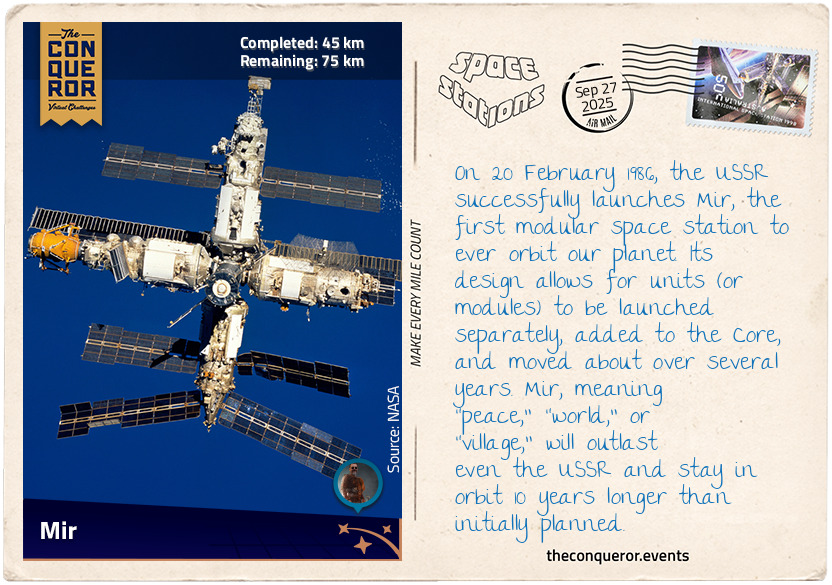
Mir is described in various ways by visitors and onlookers, from “a 100-ton Tinker Toy” to “a dragonfly with its wings outstretched” and “a hedgehog whose spines could pierce a spacewalker’s suit.” Mir doesn’t always look like that. Its chimeric appearance starts building up on 30 March 1987, when Kvant-1 (meaning “quantum”) is added to the Core Module, expanding the living space and the scientific capabilities of the station. Until 1996, five more modules, as well as a number of solar arrays and masts, are added to the space station. For a more detailed explanation of each module and its purpose, please see the “Mir Space Station Modules” spot you unlock alongside this Postcard.


Mir faces more serious problems than its aesthetics. Although the living and working space increases as modules are added, the station is plagued by clutter, lacking adequate storage space. Astronauts complain that rubbish is sometimes seen floating around the station or behind scientific instruments, as not enough room is available on returning missions to Earth to take all of it out.


The Soviet space station is, however, a scientific innovation, and the success of all the space stations to come is in no small measure linked to its existence. A record-setting 39 manned missions visit Mir between 1986 and 2000, carrying 125 people from 12 countries. The most notable missions are part of the Shuttle-Mir program, which sees nine American Shuttles dock with the Soviet Space Station.


A great number of experiments and observations are carried out on board Mir on subjects such as fluid physics, materials science, biotechnology, space debris, and the effects of long space missions on astronauts.


Some of the most successful and important experiments focus on plant growth in space. If we think about the future, to a time when humans travel to other planets and even colonise them, one of the first concerns is food. A mission can pack enough food for a relatively short stay in space, but for a long voyage with no prospect of re-stocking or for an extraplanetary colony, the crew needs to start producing its own sustenance. Star Trek-style replicators are a long way off, so humans first need to figure out how to grow things in space.


Plants are sensitive to gravity—so much so that young stems tilted only a few degrees will quickly begin righting themselves. To test whether plants can grow from seed to seed (a seed maturing in a seed-bearing plant) in microgravity, scientists devise a series of tests for the astronauts aboard Mir. Growth experiments begin almost immediately, with the cultivation of cabbages and radishes, which yield a fraction of the growth achieved by the control batch on Earth. Aside from microgravity, the astronauts deal with other problems such as the difficulty of monitoring all possible growth factors (humidity, light, drainage, etc.), lack of adequate technology, and failure of existing equipment.


As part of the Shuttle-Mir program, the US and the Russian Federation create the “Fundamental Biology” program, intended for experiments in disciplines such as avian development biology, plant biology, circadian rhythm research, and radiation monitoring. From June 1995 to December 1996, astronauts on board conduct the “Greenhouse 2” mission, which has as one of its objectives growing a complete cycle of Super-Dwarf wheat, monitor and document factors that impact its growth, collect samples and pictures, and improve its growth as much as possible.


The experiment is a success in the sense that the plants are kept alive, and a copious amount of data is collected on the whole process and the environmental factors surrounding the plants. Although the experiment does not produce any food, it offers astronauts something just as critical at the time: given the right conditions, plants can grow in space.
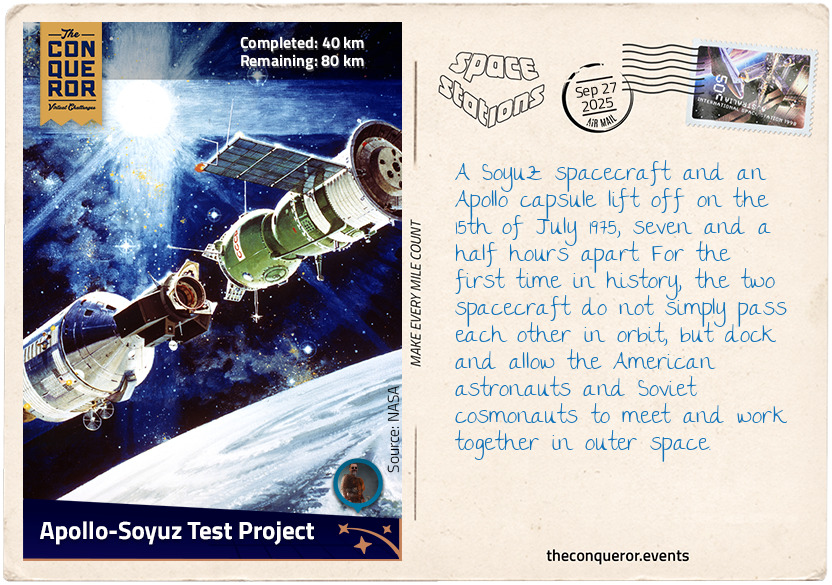
Dubbed a “handshake in space”, one of Apollo-Soyuz Test Project’s goals is the construction and testing of an androgynous docking system that can service both American and Soviet spacecraft. But perhaps more importantly, it is a symbolic meeting which signals the end of space competition and the beginning of an era of cooperation in the name of science and humanity.


Major technological and political advances are needed for this historic feat. The idea of a joint space mission is first mentioned by President John F. Kennedy as early as 1963, but the matter is taken up only seven years later through a series of letters and informal talks between NASA Administrator Thomas O. Paine and Soviet Academy of Sciences President, Mstislav V. Keldysh. Finally, the US proposes a joint mission in 1971, which is accepted by the Soviets.


Treaties and agreements also lay the basis of the cooperation between the US and the USSR. Namely, the “Outer Space Treaty”, the “Rescue Agreement” and the beautifully named “Agreement Concerning Cooperation in the Exploration and Use of Outer Space for Peaceful Purposes”. Together, they stipulate the signing parties’ responsibility of aiding any ”personnel of a spacecraft” that might be in danger in outer space, limit space exploration to peaceful motives, ban the use of nuclear weapons in space and prohibit the claiming of any celestial bodies as belonging to one nation. The last agreement also states the areas in which America and the USSR shall cooperate (exploration, environmental space medicine, etc) and the conditions under which such cooperation can take place.


Compared to the political issues, it seems that the technical problems are much smaller. However, one should not underestimate the effort and ingenuity that goes into the project. Although both the Americans and the Soviets have spacecraft are to dock, they lack a compatible docking system. The scientists start working on the problem, and upon consecutive and mutual visits to Johnson Space Centre and Moscow, the Androgynous Peripheral Attach System is designed and constructed.


The Soyuz and Apollo spacecraft never meet while on Earth; they don’t even share a hemisphere, so the millions of people watching live on television must be doing so with bated breath as the astronauts start counting the meters until “capture” (secure connection between the spacecraft). Built approximately 5936.2 miles (9553.4 km) apart, Apollo and Soyuz match perfectly and at 3.17 p.m. EDT, the hatch opens, allowing the commanders Leonov and Stafford to shake hands. The two crafts remain docked for under 50 hours, time in which the astronauts conduct joint scientific experiments.


There is something else the crew does up in orbit, and that is exchanging gifts. The crew exchange US and USSR flags, a UN flag flown up by Soyuz and returned by Apollo, commemorative plaques, and a lead-gold alloy created while in orbit, which represents “the unusual environment of space that acts as a catalyst through which both men and materials may combine to yield useful applications for the benefit of all.” However, my favourite gifts are those of tree seeds. Although not much can be confirmed about what happens to them after leaving space, I like to imagine the American astronauts bringing the seeds back to Earth and planting them, while their Soviet counterparts do the same, creating two little forests that grow still and stretch towards their symbolic birthplace: space.

I leave you now with two videos. One is the recorded docking of Apollo and Soyuz, and the other is “Privet Rados”, a Russian rendition of “Hello Darlin’” sung by Conway Twitty and played by the American astronauts to the Soviet cosmonauts while in orbit.