Under morgonen kom det sista vykortet från utmaningen Space Stations. Det åttonde i ordningen!
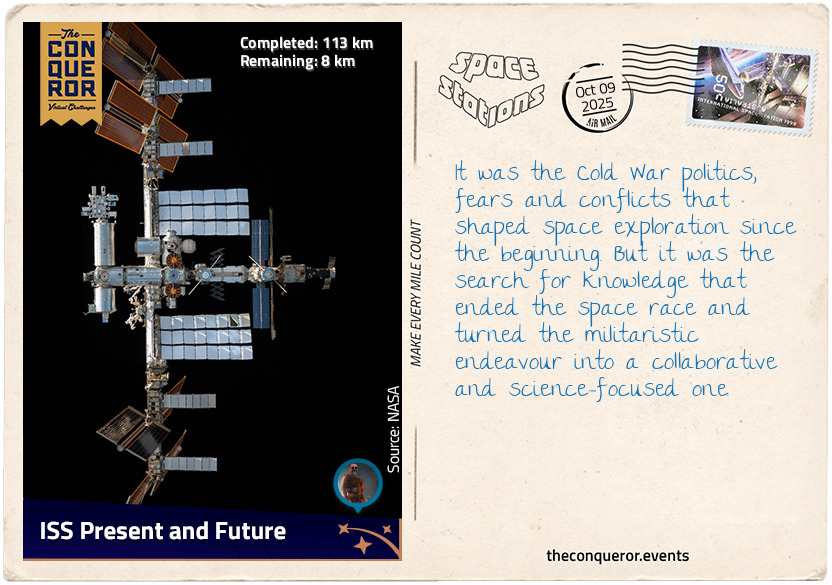
Nowadays, there is little talk about launch infrastructure when it comes to space travel and a lot more about getting to the Moon or even Mars. The work jointly conducted aboard the International Space Station by America, Russia, and the 10+ other nations is pivotal in achieving such lofty goals. But more than that, the instruments pointed down to Earth are vital and will become more so for the preservation of our only home in the universe.
From systems that detect drought and predict wildfires, to programs that develop new drugs and technologies that can offer us a better life, the ISS offers the world valuable tools for a better life on Earth. Experiments regarding human and plant life in space might offer us a good life on some other planet.
Since its first crewed mission in 2000, the ISS has welcomed more than 70 others, with astronauts from all over the world. There is an echo to the Space Race era and the Red Scare, however. Legislation put in place by the US practically bans China from participating in the ISS. The International Space Station shared Earth’s orbit for a brief period of time with Mir, but for 20 years, no other permanently occupied spacecraft orbited Earth. In 2021, the Chinese Manned Space Agency sent Tiangong (which translates as “Heavenly Palace”) into space and began a permanent presence in space.
If this is a sign of yet another space rivalry or the beginning of an orbit full of space stations conducting research and sharing data for the betterment of all living on Earth, it remains to be seen.
ISS’s operational life ends in 2030, and plans for its controlled deorbiting are already in place. Mir overstayed in orbit by 10 years, and Voyager probes are still hurtling through space, so I foster a secret hope that the International Space Station might remain in space a while longer.
For now, however, the International Space Station still orbits the Earth around 16 times a day, every day. Due to its size, it can be spotted with the naked eye, and NASA has a few tips on how to do it, which I’ll leave with you here. While you look up and your eyes narrow on the little light crossing the skies of your nation, try to remember that you are looking at the result of decades of space rivalry and cooperation. The ISS symbolises the tremendous achievements gained from international collaboration and goodwill. Since we had eyes to see, we trained them on the stars and longed to touch them. This will probably remain true in the future, so while you follow the ISS, try keeping in mind that it is not only the past you’re looking at, but also the very beginning of our future in space.
Senare på morgonkvisten, ganska exakt kl. 09:28, så passerade även jag mållinjen i Space Stations!
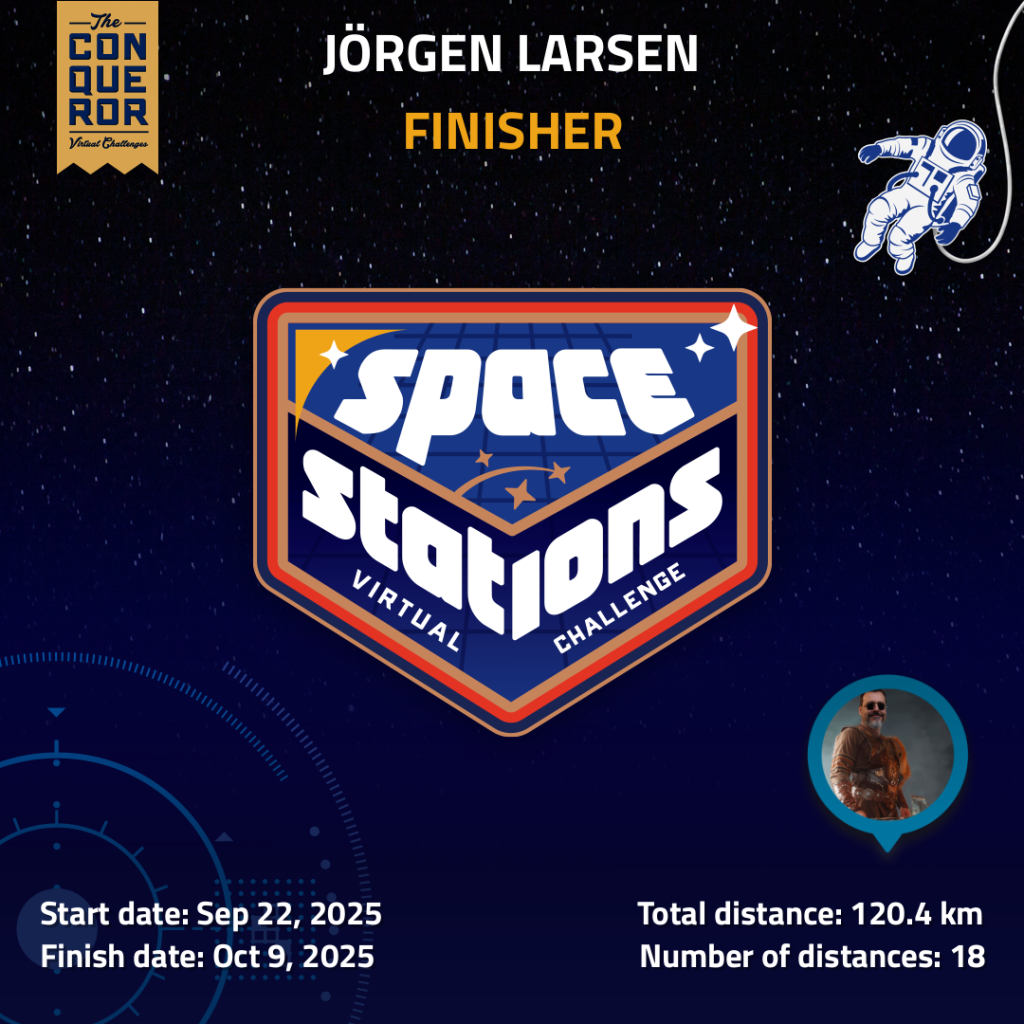
Därmed var Gabriel och jag båda klara med våra tre utmaningar i serien Space Race!