I natt kom det sjunde vykortet från Gabriels och min utmaning Space Stations. Gabriel gick om mig och ligger ca: 2km före just nu!
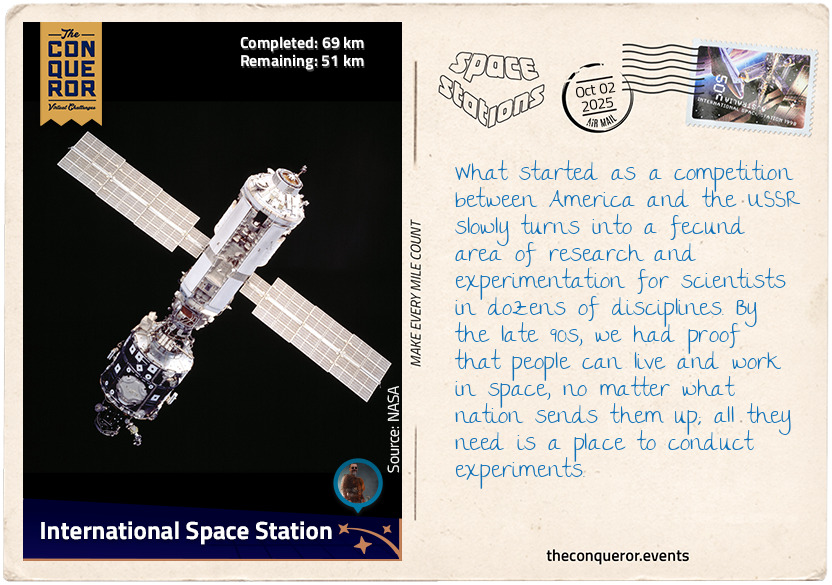
On 20th of November 1998, the US-funded and Russian-built module named Zarya launches from Kazakhstan. This component is the first building block of the International Space Station, and its name, meaning “sunrise”, is chosen to symbolise a new dawn in collaborative space exploration.
Zarya is joined in December of the same year by the Unity Module, carried into orbit by Space Shuttle Endeavour. The now connected Russian and American modules form the core of the ISS, and although they are less important for the station’s functioning now, they remain part of it today.
On 2nd of November 2000, the ISS is finally ready to welcome its first human inhabitants. Space veterans Bill Shepherd, Yuri Gidzenko and Sergei Krikalev become the first astronauts to visit it and to initiate the uninterrupted human occupation of the station. The three men spend 136 days aboard the station and activate various systems, unload equipment and experiments from uncrewed Russian spacecraft and host two visiting Shuttle missions.
Over the years, the International Space Station has welcomed 6 more Russian modules and 8 American ones. What makes the station truly international, however, is the hardware contribution from space agencies from Europe, Japan and Canada and the access to astronauts from over 20 nations. As the habitable area grows, so do the scientific capabilities of the station, making it a unique and invaluable space for conducting research in a variety of fields.
Until the present day, over 3000 experiments are conducted aboard the ISS, some of them expand our understanding of subjects researched since the first space station, such as the effects of microgravity on the human body, the growth of plants in space and Earth monitoring. Experiments regarding muscle and bone loss not only improve the health of astronauts, but are now used to understand and combat the effects of osteoporosis in people back on Earth. Since the puny harvests of Super-Dwarf wheat on Mir, scientists have managed to grow a variety of plants onboard ISS, such as three types of lettuce, red Russian kale, zinnia flowers and chilli peppers.
Samtidigt kom det besked om att vi passerat 60% av den totala sträckan och att ännu ett träd blivit planterat!
 Milestone Treeplant