Denna morgon vaknade man upp med två vykort i brevlådan, från Gabriel och min utmaning ”Space Stations”. Detta efter totalt 80 km avverkade.
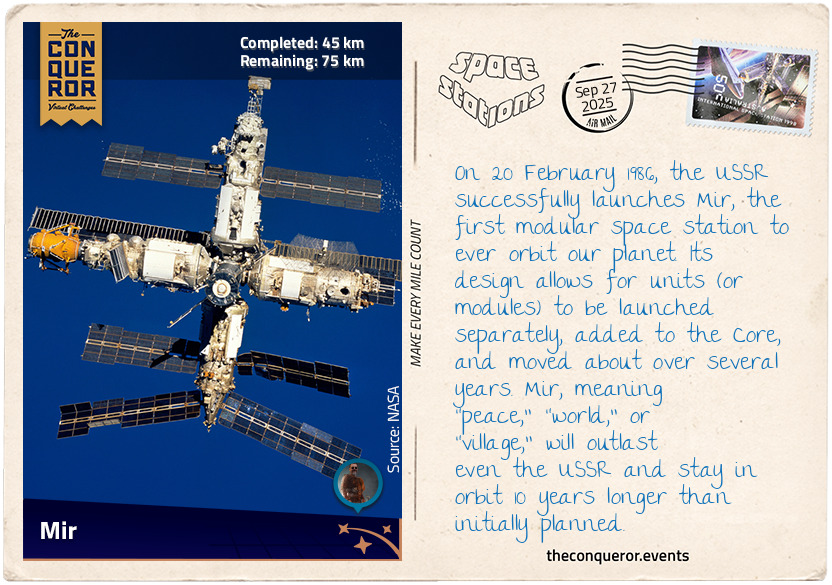
Mir is described in various ways by visitors and onlookers, from “a 100-ton Tinker Toy” to “a dragonfly with its wings outstretched” and “a hedgehog whose spines could pierce a spacewalker’s suit.” Mir doesn’t always look like that. Its chimeric appearance starts building up on 30 March 1987, when Kvant-1 (meaning “quantum”) is added to the Core Module, expanding the living space and the scientific capabilities of the station. Until 1996, five more modules, as well as a number of solar arrays and masts, are added to the space station. For a more detailed explanation of each module and its purpose, please see the “Mir Space Station Modules” spot you unlock alongside this Postcard.
Mir faces more serious problems than its aesthetics. Although the living and working space increases as modules are added, the station is plagued by clutter, lacking adequate storage space. Astronauts complain that rubbish is sometimes seen floating around the station or behind scientific instruments, as not enough room is available on returning missions to Earth to take all of it out.
The Soviet space station is, however, a scientific innovation, and the success of all the space stations to come is in no small measure linked to its existence. A record-setting 39 manned missions visit Mir between 1986 and 2000, carrying 125 people from 12 countries. The most notable missions are part of the Shuttle-Mir program, which sees nine American Shuttles dock with the Soviet Space Station.
A great number of experiments and observations are carried out on board Mir on subjects such as fluid physics, materials science, biotechnology, space debris, and the effects of long space missions on astronauts.
Some of the most successful and important experiments focus on plant growth in space. If we think about the future, to a time when humans travel to other planets and even colonise them, one of the first concerns is food. A mission can pack enough food for a relatively short stay in space, but for a long voyage with no prospect of re-stocking or for an extraplanetary colony, the crew needs to start producing its own sustenance. Star Trek-style replicators are a long way off, so humans first need to figure out how to grow things in space.
Plants are sensitive to gravity—so much so that young stems tilted only a few degrees will quickly begin righting themselves. To test whether plants can grow from seed to seed (a seed maturing in a seed-bearing plant) in microgravity, scientists devise a series of tests for the astronauts aboard Mir. Growth experiments begin almost immediately, with the cultivation of cabbages and radishes, which yield a fraction of the growth achieved by the control batch on Earth. Aside from microgravity, the astronauts deal with other problems such as the difficulty of monitoring all possible growth factors (humidity, light, drainage, etc.), lack of adequate technology, and failure of existing equipment.
As part of the Shuttle-Mir program, the US and the Russian Federation create the “Fundamental Biology” program, intended for experiments in disciplines such as avian development biology, plant biology, circadian rhythm research, and radiation monitoring. From June 1995 to December 1996, astronauts on board conduct the “Greenhouse 2” mission, which has as one of its objectives growing a complete cycle of Super-Dwarf wheat, monitor and document factors that impact its growth, collect samples and pictures, and improve its growth as much as possible.
The experiment is a success in the sense that the plants are kept alive, and a copious amount of data is collected on the whole process and the environmental factors surrounding the plants. Although the experiment does not produce any food, it offers astronauts something just as critical at the time: given the right conditions, plants can grow in space.
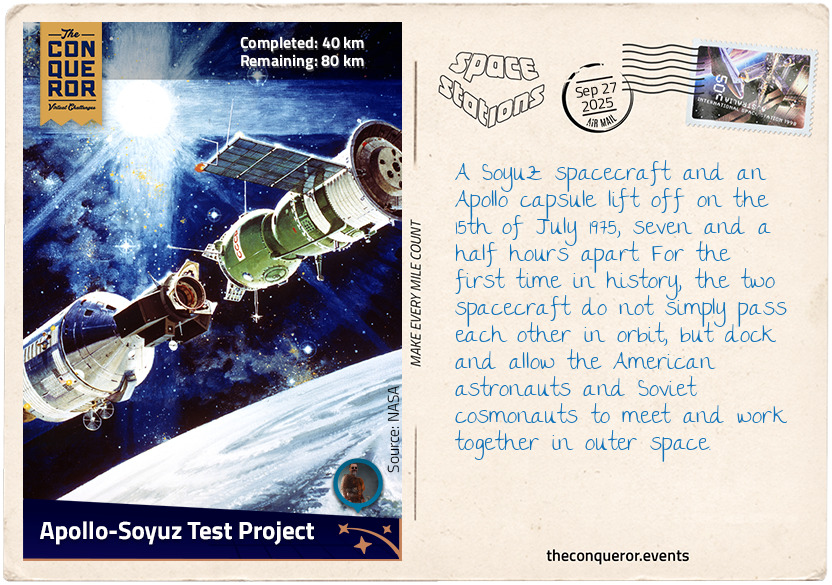
Dubbed a “handshake in space”, one of Apollo-Soyuz Test Project’s goals is the construction and testing of an androgynous docking system that can service both American and Soviet spacecraft. But perhaps more importantly, it is a symbolic meeting which signals the end of space competition and the beginning of an era of cooperation in the name of science and humanity.
Major technological and political advances are needed for this historic feat. The idea of a joint space mission is first mentioned by President John F. Kennedy as early as 1963, but the matter is taken up only seven years later through a series of letters and informal talks between NASA Administrator Thomas O. Paine and Soviet Academy of Sciences President, Mstislav V. Keldysh. Finally, the US proposes a joint mission in 1971, which is accepted by the Soviets.
Treaties and agreements also lay the basis of the cooperation between the US and the USSR. Namely, the “Outer Space Treaty”, the “Rescue Agreement” and the beautifully named “Agreement Concerning Cooperation in the Exploration and Use of Outer Space for Peaceful Purposes”. Together, they stipulate the signing parties’ responsibility of aiding any ”personnel of a spacecraft” that might be in danger in outer space, limit space exploration to peaceful motives, ban the use of nuclear weapons in space and prohibit the claiming of any celestial bodies as belonging to one nation. The last agreement also states the areas in which America and the USSR shall cooperate (exploration, environmental space medicine, etc) and the conditions under which such cooperation can take place.
Compared to the political issues, it seems that the technical problems are much smaller. However, one should not underestimate the effort and ingenuity that goes into the project. Although both the Americans and the Soviets have spacecraft are to dock, they lack a compatible docking system. The scientists start working on the problem, and upon consecutive and mutual visits to Johnson Space Centre and Moscow, the Androgynous Peripheral Attach System is designed and constructed.
The Soyuz and Apollo spacecraft never meet while on Earth; they don’t even share a hemisphere, so the millions of people watching live on television must be doing so with bated breath as the astronauts start counting the meters until “capture” (secure connection between the spacecraft). Built approximately 5936.2 miles (9553.4 km) apart, Apollo and Soyuz match perfectly and at 3.17 p.m. EDT, the hatch opens, allowing the commanders Leonov and Stafford to shake hands. The two crafts remain docked for under 50 hours, time in which the astronauts conduct joint scientific experiments.
There is something else the crew does up in orbit, and that is exchanging gifts. The crew exchange US and USSR flags, a UN flag flown up by Soyuz and returned by Apollo, commemorative plaques, and a lead-gold alloy created while in orbit, which represents “the unusual environment of space that acts as a catalyst through which both men and materials may combine to yield useful applications for the benefit of all.” However, my favourite gifts are those of tree seeds. Although not much can be confirmed about what happens to them after leaving space, I like to imagine the American astronauts bringing the seeds back to Earth and planting them, while their Soviet counterparts do the same, creating two little forests that grow still and stretch towards their symbolic birthplace: space.
I leave you now with two videos. One is the recorded docking of Apollo and Soyuz, and the other is “Privet Rados”, a Russian rendition of “Hello Darlin’” sung by Conway Twitty and played by the American astronauts to the Soviet cosmonauts while in orbit.