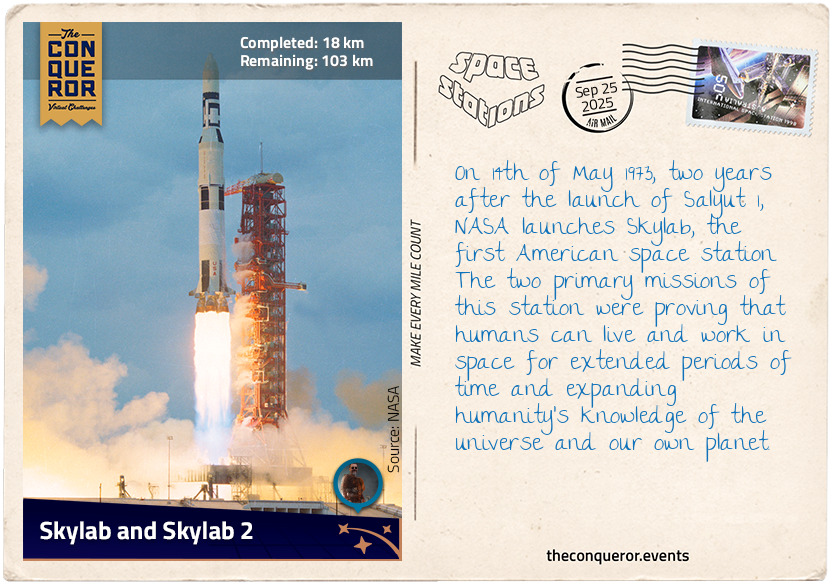
A more practical reason for building Skylab was also the repurposing of equipment left over from the Apollo and Saturn rocket missions. Thus, Orbital Workshop, Skylab’s largest and most important section, designed for research and crew habitation, was constructed using a “dry” third stage of the Saturn V rocket. The “dry” description refers to the fact that the lab was already set up before launch and ready to be used once in orbit. The other three main components were the Airlock Module (used for extravehicular walks), the Multiple Docking Adapter (which holds the Earth Resources Experiment Package and allows crews to dock with the station) and the Apollo Telescope Mount (primarily used for solar observations).
Right after the launch, the spacecraft suffers an early deployment of its micrometeoroid shield, which results in the component becoming detached. This shield is designed to protect the spacecraft against two things that Earth’s atmosphere takes care of for us: space debris and the sun’s heat radiation. Moreover, one of the solar arrays, which was designed to generate energy for the station, is missing, while the other is only partially deployed, as the micrometeoroid shield wreckage is blocking it. All this means that the Orbital Workshop is in danger of becoming too hot for any crew to come onboard, and delicate equipment is at risk of getting damaged. The loss of the solar array means that the Skylab was underpowered. This presents ground control with a problem: the station has to be aligned just so to receive maximum solar exposure on the remaining solar array to maintain an appropriate amount of power, but at the same time, the exposed segment which was supposed to be protected from the sun, has to be shielded as much as possible to prevent overheating. A mad rush ensues for the creation of a lightweight but durable cover that the first manned mission to Skylab could carry and deploy.
On the 25th of May 1973, Commander Charles “Pete” Conrad, Pilot Paul J. Weitz, and Science Pilot Joseph P. Kerwin successfully take off, beginning the (confusingly named) Skylab 2 mission. The crew completes a fly-around of the space station and finally offers visual confirmation of the damage. After a failed attempt at freeing the trapped solar array, the crew docks with Skylab. The next day, the astronauts enter the Orbital Workshop, which was now registering 130°F (54°C) and proceed to deploy a parasol that would cling to the station’s exterior and bring the internal temperature down. With that in place, the crew directs their attention to the trapped solar array. After 3 hours and 25 minutes (the longest spacewalk in Earth orbit up to that point), the astronauts manage to free it, and their mission can fully begin.
The Skylab 2 crew completes 404 orbits around the Earth, amassing 28 days, more than double the US record at that time. Although much of their allotted time for research was taken up by the urgent repairs, the 3 astronauts successfully completed 81% of the planned solar experiments, 88% of the planned Earth observations and 90% of the planned medical experiments.
Dessutom fick vi beskedet att vi passerat 20% av den totala sträckan och därmed planterat ännu ett träd.
 Milestone Treeplant