Efter gårdagens steginsamling, kom det första vykortet i resan till Space Stations.
Detta efter 5 km avverkat.
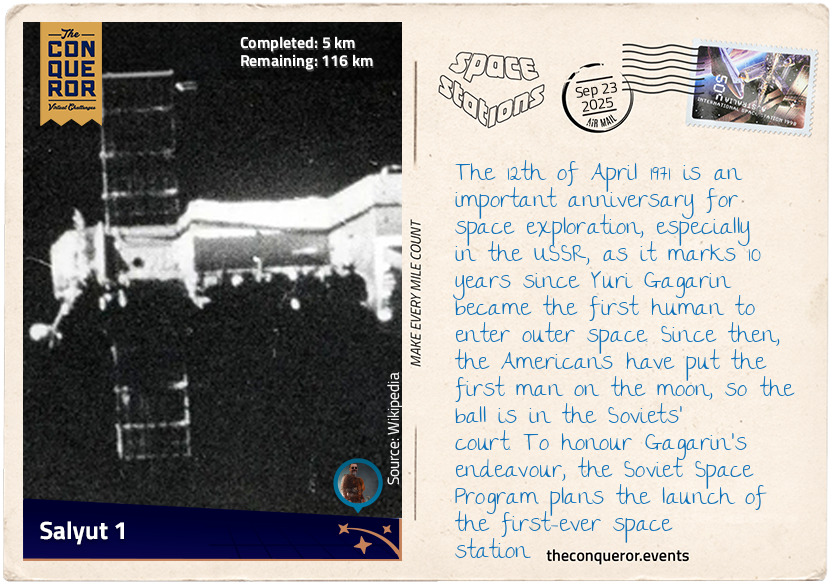
A space station named Zarya (“sunrise” in Russian) was to be launched from Baikonur Cosmodrome in Kazakhstan, but, in a manner of speaking, Zarya never left the pad. Just days before the launch, a decision was taken to rename the space station Salyut (“salute” or “firework” in Russian). With a new name came also a new launch date, as technical hiccups pushed it to the 19th of April. This was no longer exactly ten years after Gagarin’s space journey, but it is still before an American space station and is an extraordinary technological and scientific feat.
Still having “Zarya” painted on the side, Salyut lifted off from the same pad that sent the first man into space. The 20 metric ton structure was sent into lower orbit by a Proton-K rocket, and within 9 minutes, the space station was orbiting Earth.
Salyut was designed to be capable of docking with a Soyuz spacecraft carrying crew and supplies, so only four days after entering the lower orbit, the space station was visited by the first manned mission, aboard Soyuz 10. The three astronauts (Vladimir A. Shatalov, Aleksei S. Yeliseyev and Nikolai N. Rukavishnikov), however, had to turn back before ever stepping on the station, as the docking failed and they could not enter the module. On 6th of June 1971, Georgy Dobrovolsky, Vladislav Volkov, and Viktor Patsayev reached Salyut aboard Soyuz 11 and successfully docked the next day, thus starting the record-setting 24-day mission.
Being the first space station in orbit offered Salyut many other “firsts”, such as being the location of the first birthday in space (Patsayev turned 38 while onboard). Unfortunately, it is also linked to the first deaths in outer space; although nobody died aboard, the Soyuz 11 crew never reached Earth alive, as their capsule depressurised and lost its oxygen after undocking from the Salyut.
After six months and more than 2,900 orbits around Earth, Salyut was put into a controlled destructive reentry into the atmosphere and disintegrated over the Pacific Ocean.
Although short-lived, the Salyut 1 brought many advancements that paved the way for all the space stations to come. Soyuz 11’s crew conducted experiments involving growing plants in 0 gravity (such as flax, onions and cabbage) and were test subjects for space living. The cosmonauts gathered valuable data regarding the effects of long space journeys on the human body, especially on the muscles and the cardiovascular system, later inspiring scientists to create specialised equipment such as the “Penguin” Prophylactic Body-loading Suit, which simulates gravity, thus ameliorating the effects of prolonged microgravity on the human body. The Soyuz 11 tragedy was itself a learning point. Because the crew could’ve been saved if they had worn pressurised suits, this became standard procedure on all future space missions, including NASA’s.