Familjen Larsen's Reseblogg

Around the world with us!

Category Conqueror Virtual Challenges

Lördag morgon och två vykort.

Denna morgon vaknade man upp med två vykort i brevlådan, från Gabriel och min utmaning ”Space Stations”. Detta efter totalt 80 km avverkade.

Mir is described in various ways by visitors and onlookers, from “a 100-ton Tinker Toy” to “a dragonfly with its wings outstretched” and “a hedgehog whose spines could pierce a spacewalker’s suit.” Mir doesn’t always look like that. Its chimeric appearance starts building up on 30 March 1987, when Kvant-1 (meaning “quantum”) is added to the Core Module, expanding the living space and the scientific capabilities of the station. Until 1996, five more modules, as well as a number of solar arrays and masts, are added to the space station. For a more detailed explanation of each module and its purpose, please see the “Mir Space Station Modules” spot you unlock alongside this Postcard.


Mir faces more serious problems than its aesthetics. Although the living and working space increases as modules are added, the station is plagued by clutter, lacking adequate storage space. Astronauts complain that rubbish is sometimes seen floating around the station or behind scientific instruments, as not enough room is available on returning missions to Earth to take all of it out.


The Soviet space station is, however, a scientific innovation, and the success of all the space stations to come is in no small measure linked to its existence. A record-setting 39 manned missions visit Mir between 1986 and 2000, carrying 125 people from 12 countries. The most notable missions are part of the Shuttle-Mir program, which sees nine American Shuttles dock with the Soviet Space Station.


A great number of experiments and observations are carried out on board Mir on subjects such as fluid physics, materials science, biotechnology, space debris, and the effects of long space missions on astronauts.


Some of the most successful and important experiments focus on plant growth in space. If we think about the future, to a time when humans travel to other planets and even colonise them, one of the first concerns is food. A mission can pack enough food for a relatively short stay in space, but for a long voyage with no prospect of re-stocking or for an extraplanetary colony, the crew needs to start producing its own sustenance. Star Trek-style replicators are a long way off, so humans first need to figure out how to grow things in space.


Plants are sensitive to gravity—so much so that young stems tilted only a few degrees will quickly begin righting themselves. To test whether plants can grow from seed to seed (a seed maturing in a seed-bearing plant) in microgravity, scientists devise a series of tests for the astronauts aboard Mir. Growth experiments begin almost immediately, with the cultivation of cabbages and radishes, which yield a fraction of the growth achieved by the control batch on Earth. Aside from microgravity, the astronauts deal with other problems such as the difficulty of monitoring all possible growth factors (humidity, light, drainage, etc.), lack of adequate technology, and failure of existing equipment.


As part of the Shuttle-Mir program, the US and the Russian Federation create the “Fundamental Biology” program, intended for experiments in disciplines such as avian development biology, plant biology, circadian rhythm research, and radiation monitoring. From June 1995 to December 1996, astronauts on board conduct the “Greenhouse 2” mission, which has as one of its objectives growing a complete cycle of Super-Dwarf wheat, monitor and document factors that impact its growth, collect samples and pictures, and improve its growth as much as possible.


The experiment is a success in the sense that the plants are kept alive, and a copious amount of data is collected on the whole process and the environmental factors surrounding the plants. Although the experiment does not produce any food, it offers astronauts something just as critical at the time: given the right conditions, plants can grow in space.

Dubbed a “handshake in space”, one of Apollo-Soyuz Test Project’s goals is the construction and testing of an androgynous docking system that can service both American and Soviet spacecraft. But perhaps more importantly, it is a symbolic meeting which signals the end of space competition and the beginning of an era of cooperation in the name of science and humanity.


Major technological and political advances are needed for this historic feat. The idea of a joint space mission is first mentioned by President John F. Kennedy as early as 1963, but the matter is taken up only seven years later through a series of letters and informal talks between NASA Administrator Thomas O. Paine and Soviet Academy of Sciences President, Mstislav V. Keldysh. Finally, the US proposes a joint mission in 1971, which is accepted by the Soviets.


Treaties and agreements also lay the basis of the cooperation between the US and the USSR. Namely, the “Outer Space Treaty”, the “Rescue Agreement” and the beautifully named “Agreement Concerning Cooperation in the Exploration and Use of Outer Space for Peaceful Purposes”. Together, they stipulate the signing parties’ responsibility of aiding any ”personnel of a spacecraft” that might be in danger in outer space, limit space exploration to peaceful motives, ban the use of nuclear weapons in space and prohibit the claiming of any celestial bodies as belonging to one nation. The last agreement also states the areas in which America and the USSR shall cooperate (exploration, environmental space medicine, etc) and the conditions under which such cooperation can take place.


Compared to the political issues, it seems that the technical problems are much smaller. However, one should not underestimate the effort and ingenuity that goes into the project. Although both the Americans and the Soviets have spacecraft are to dock, they lack a compatible docking system. The scientists start working on the problem, and upon consecutive and mutual visits to Johnson Space Centre and Moscow, the Androgynous Peripheral Attach System is designed and constructed.


The Soyuz and Apollo spacecraft never meet while on Earth; they don’t even share a hemisphere, so the millions of people watching live on television must be doing so with bated breath as the astronauts start counting the meters until “capture” (secure connection between the spacecraft). Built approximately 5936.2 miles (9553.4 km) apart, Apollo and Soyuz match perfectly and at 3.17 p.m. EDT, the hatch opens, allowing the commanders Leonov and Stafford to shake hands. The two crafts remain docked for under 50 hours, time in which the astronauts conduct joint scientific experiments.


There is something else the crew does up in orbit, and that is exchanging gifts. The crew exchange US and USSR flags, a UN flag flown up by Soyuz and returned by Apollo, commemorative plaques, and a lead-gold alloy created while in orbit, which represents “the unusual environment of space that acts as a catalyst through which both men and materials may combine to yield useful applications for the benefit of all.” However, my favourite gifts are those of tree seeds. Although not much can be confirmed about what happens to them after leaving space, I like to imagine the American astronauts bringing the seeds back to Earth and planting them, while their Soviet counterparts do the same, creating two little forests that grow still and stretch towards their symbolic birthplace: space.

I leave you now with two videos. One is the recorded docking of Apollo and Soyuz, and the other is “Privet Rados”, a Russian rendition of “Hello Darlin’” sung by Conway Twitty and played by the American astronauts to the Soviet cosmonauts while in orbit.

27 km och ett vykort

Då har vi tagit oss 27 km på vår resa och vykort nr.3 kom från Space Stations.

Skylab 3 – not the 3rd space station, but the second manned mission to Skylab – launches on the 28th of July 1973, and its crew begins their first task: deploying a more permanent sunshade to protect the Orbital Workshop. They accomplish this during a 6-hour and 29-minute spacewalk (a record for an extravehicular mission in orbit at that time). Once the sunshade is in place, the temperature drops into a more comfortable range, allowing the astronauts to turn their minds to their planned experiments and observations.

Alongside Alan L. Bean, Owen K. Garriott and Jack R. Lousma, the mission involves 2 minnows, 50 minnow eggs, 6 pocket mice, 720 fruit fly pupae and 2 spiders named Arabella and Anita. The animals are used in experiments concerning their behaviour in space, such as web-spinning abilities.


Aside from the deep space, astronauts turn their eyes and minds towards Earth. The Earth Resources Experiment Package, located in the Multiple Docking Adapter, permits them to observe our planet in visible, infrared and microwave spectra. The naked eye proves to be a powerful detection tool as well, as the crew can observe the forming of Hurricane Ellen over the Atlantic. The astronauts recognise that the data only they can gather benefits meteorologists back on Earth, so they take stereo photographs of the event, which provide scientists with invaluable insight into cloud formation.


The 3 men safely get back to Earth after 59 days, 858 orbits around the Earth, and after achieving all of their mission goals. Moreover, because they are given a more intense exercise programme as well as a more calorie-dense diet than the previous missions, they return in better physical shape than previous astronauts.


On the 16th of November 1973, Gerald P. Carr, Dr. Edward G. Gibson and Lt. Col. William Pogue form the crew of Skylab 4, which is to be the last manned mission to Skylab. Keeping in tradition with the other missions, they start their space sojourn by fixing something, namely the coolant systems in the Airlock Module.


Aside from running experiments and observations, the 3 astronauts are also tasked with monitoring comet Kohoutek as their mission overlaps nicely with the period of time the comet comes closer to Earth. Kohoutek excites all space enthusiasts down on Earth as it is expected to be very bright. The nickname “Comet of the Century” quickly changes to “The Disappointment of the Century” as the space object turns out to be barely visible to the naked eye. However, armed with better tools and a great view of Kohoutek, the astronauts are able to monitor its passing very closely and gather exquisite data.


The mission is initially planned for 54 days, but it is subject to extension on a week-by-week basis up to 84 days. The longer the astronauts spend in space, the more dangerous microgravity and radiation become for their bodies, so they are instructed to exercise for even longer periods of time. Every minute in space is valuable and expensive, so the scientists back home cram as much work into the astronauts’ timetable as they possibly can. The work is exhausting, but the men are tough and know what they signed up for. There is an urban legend that, having had enough, one day, the astronauts simply shut off all communications and take an unplanned day off. The crew’s issues are real, but their demands are solved by a frank conversation, and they manage to wrangle 1 day completely off every 10 days and less work done immediately before and after sleep. But we can take a moment and imagine the astronauts floating in space, with no critical mission at hand, nothing to fix, report or observe. We can imagine them looking around the thin cylinder separating them from the void of the universe, the cylinder that keeps them alive for weeks and seeing it not just as a workplace or a lab, but as a home. We can imagine them gazing out of the windows and yearning for the verdant home, waiting for their return.


Skylab 4 marks an interesting first. Between December 18th and 26th, cosmonauts Pyotr Klimuk and Valentin Lebedev conduct some experiments as part of the Soyuz 13 mission. Although the American and Soviet astronauts never met in space, this is the first time the two nations’ crews orbit Earth at the same time. A glimpse of things to come.


All good things must come to an end.. One of the most important tasks for the ground crew is to keep the space station at the correct altitude. This becomes increasingly difficult because higher-than-expected solar activity causes the Earth’s orbit to expand, thus increasing the drag on Skylab and causing it to come to an altitude of 250 miles. Various rescue missions that involve booster rockets are discussed, but in the end, a controlled deorbiting is scheduled for the space station.


On 11th of July 1979, Skylab re-enters Earth’s atmosphere, where most of it burns up, while some parts fall over the ocean and uninhabited parts of Australia. After 171 occupied days, 3 crewed missions, almost 300 technical and scientific experiments, and countless hours of observations, Skylab’s luminous 6 years in space end in a blaze of glory.

Andra vykortet kom efter 18km.

A more practical reason for building Skylab was also the repurposing of equipment left over from the Apollo and Saturn rocket missions. Thus, Orbital Workshop, Skylab’s largest and most important section, designed for research and crew habitation, was constructed using a “dry” third stage of the Saturn V rocket. The “dry” description refers to the fact that the lab was already set up before launch and ready to be used once in orbit. The other three main components were the Airlock Module (used for extravehicular walks), the Multiple Docking Adapter (which holds the Earth Resources Experiment Package and allows crews to dock with the station) and the Apollo Telescope Mount (primarily used for solar observations).


Right after the launch, the spacecraft suffers an early deployment of its micrometeoroid shield, which results in the component becoming detached. This shield is designed to protect the spacecraft against two things that Earth’s atmosphere takes care of for us: space debris and the sun’s heat radiation. Moreover, one of the solar arrays, which was designed to generate energy for the station, is missing, while the other is only partially deployed, as the micrometeoroid shield wreckage is blocking it. All this means that the Orbital Workshop is in danger of becoming too hot for any crew to come onboard, and delicate equipment is at risk of getting damaged. The loss of the solar array means that the Skylab was underpowered. This presents ground control with a problem: the station has to be aligned just so to receive maximum solar exposure on the remaining solar array to maintain an appropriate amount of power, but at the same time, the exposed segment which was supposed to be protected from the sun, has to be shielded as much as possible to prevent overheating. A mad rush ensues for the creation of a lightweight but durable cover that the first manned mission to Skylab could carry and deploy.


On the 25th of May 1973, Commander Charles “Pete” Conrad, Pilot Paul J. Weitz, and Science Pilot Joseph P. Kerwin successfully take off, beginning the (confusingly named) Skylab 2 mission. The crew completes a fly-around of the space station and finally offers visual confirmation of the damage. After a failed attempt at freeing the trapped solar array, the crew docks with Skylab. The next day, the astronauts enter the Orbital Workshop, which was now registering 130°F (54°C) and proceed to deploy a parasol that would cling to the station’s exterior and bring the internal temperature down. With that in place, the crew directs their attention to the trapped solar array. After 3 hours and 25 minutes (the longest spacewalk in Earth orbit up to that point), the astronauts manage to free it, and their mission can fully begin.


The Skylab 2 crew completes 404 orbits around the Earth, amassing 28 days, more than double the US record at that time. Although much of their allotted time for research was taken up by the urgent repairs, the 3 astronauts successfully completed 81% of the planned solar experiments, 88% of the planned Earth observations and 90% of the planned medical experiments. 

Dessutom fick vi beskedet att vi passerat 20% av den totala sträckan och därmed planterat ännu ett träd.

Milestone Treeplant

Space Stations första vykort

Efter gårdagens steginsamling, kom det första vykortet i resan till Space Stations.

Detta efter 5 km avverkat.

A space station named Zarya (“sunrise” in Russian) was to be launched from Baikonur Cosmodrome in Kazakhstan, but, in a manner of speaking, Zarya never left the pad. Just days before the launch, a decision was taken to rename the space station Salyut (“salute” or “firework” in Russian). With a new name came also a new launch date, as technical hiccups pushed it to the 19th of April. This was no longer exactly ten years after Gagarin’s space journey, but it is still before an American space station and is an extraordinary technological and scientific feat.


Still having “Zarya” painted on the side, Salyut lifted off from the same pad that sent the first man into space. The 20 metric ton structure was sent into lower orbit by a Proton-K rocket, and within 9 minutes, the space station was orbiting Earth. 


Salyut was designed to be capable of docking with a Soyuz spacecraft carrying crew and supplies, so only four days after entering the lower orbit, the space station was visited by the first manned mission, aboard Soyuz 10. The three astronauts (Vladimir A. Shatalov, Aleksei S. Yeliseyev and Nikolai N. Rukavishnikov), however, had to turn back before ever stepping on the station, as the docking failed and they could not enter the module. On 6th of June 1971, Georgy Dobrovolsky, Vladislav Volkov, and Viktor Patsayev reached Salyut aboard Soyuz 11 and successfully docked the next day, thus starting the record-setting 24-day mission. 


Being the first space station in orbit offered Salyut many other “firsts”, such as being the location of the first birthday in space (Patsayev turned 38 while onboard). Unfortunately, it is also linked to the first deaths in outer space; although nobody died aboard, the Soyuz 11 crew never reached Earth alive, as their capsule depressurised and lost its oxygen after undocking from the Salyut. 


After six months and more than 2,900 orbits around Earth, Salyut was put into a controlled destructive reentry into the atmosphere and disintegrated over the Pacific Ocean. 


Although short-lived, the Salyut 1 brought many advancements that paved the way for all the space stations to come. Soyuz 11’s crew conducted experiments involving growing plants in 0 gravity (such as flax, onions and cabbage) and were test subjects for space living. The cosmonauts gathered valuable data regarding the effects of long space journeys on the human body, especially on the muscles and the cardiovascular system, later inspiring scientists to create specialised equipment such as the “Penguin” Prophylactic Body-loading Suit, which simulates gravity, thus ameliorating the effects of prolonged microgravity on the human body. The Soyuz 11 tragedy was itself a learning point. Because the crew could’ve been saved if they had worn pressurised suits, this became standard procedure on all future space missions, including NASA’s.

Nionde vykortet från månen.

Over the next few years, the Apollo missions would continue. Apollo 12 sends the second manned mission to the Moon on November 14, 1969, during which time astronauts Alan Bean and Pete Conrad perform two moonwalks (on our natural satellite, not the dancefloor). 


Then, on April 11, 1970, the Apollo 13 mission takes off. This mission ends in disaster after 2 days in space when a liquid oxygen tank in the service module explodes, crippling the spacecraft. Luckily, the crew manages to abort the mission and splash down on Earth safely. 


Finally, Apollo 17 takes off in 1972, marking the last time human beings have set foot on the Moon. The Soviets, for their part, never will put a cosmonaut on the Moon.

Interpretations of the Space Race vary. With the Lunar landing, it’s easy to stake the claim that the USA won the Space Race. The landing of two humans on the Moon was an extremely complex and risky technological endeavour, requiring an unprecedented amount of expertise, meticulous planning and technological prowess. There is no more iconic image in the Space Race than that of Neil Armstrong on the Moon, and with it, the Americans scored a huge propaganda victory over the Soviets. This has persisted even today; most people tend to interpret the American landing on the Moon as marking their victory in the Space Race.


But more subtle interpretations are also fun to entertain. The anthropologist David Graeber has provocatively described the Moon landings as the ‘Soviet Union’s Greatest Achievement”, arguing that without the external pressure of a rival superpower with an ambitious space exploration project, the USA would never have been spurred on to explore space. The two superpowers worked in tandem in a way, the success of one side encouraging the other to pursue even loftier goals. Graeber’s interpretation is strengthened by the fact that, after the USA emerged from the Cold War as the only global superpower, it has never attempted as ambitious a goal as space travel.


Both Walter A. McDougall, in his famous political history of the Space Age, and Graeber take the argument further. They point out that, to marshal the huge resources, manpower and expertise needed to reach the Moon, the capitalist USA, which on paper claimed that the free market and private enterprise were the best ways to create human flourishing, was forced to adopt the principles of Soviet communism. Instead of a privatised company carrying out the Lunar landings, the USA harnessed the power of the state. When the US government wanted to do something as costly, long-term and ambitious as space travel, big government was needed – top-down, publicly funded (or socialised), operated not within the profit motive that capitalism champions, but for a loftier aim. McDougall called the political apparatus behind the Moon landings a ‘technocracy’, a state-directed vision of scientific progress led by public money and civilian participation rather than the private sector and market forces.


This interpretation asks us to consider the fact that, whilst the USA may have claimed victory in the Space Race, it was forced to adopt some of the techniques and structures of Soviet communism and central planning to get there. If the Space Race is seen as a competition between the ideologies of communism and capitalism to see which belief system could best marshal its nation’s resources and the talent of its citizens, who the winner was is much less clear. 


So far, we have seen the stakes of the Space Race become less militarised, and the competitions more good-natured. We have seen the paranoid and volatile post-war arms race evolve into a contest based increasingly on the principles of discovery and technological innovation, with even the occasional friendly gesture between the two powers (i.e Armstrong’s plaque, or Krushchev’s gift to Kennedy). Now, as our story moves into its final chapter, these positive aspects of the Race will deepen, and the two superpowers begin to compete and collaborate on a series of missions intended to establish a semi-permanent human presence in space. 

Äntligen uppe på månen

Då var vi äntligen framme och har satt fötterna på månen!

Gabriel gick i mål strax före mig.

På måndag 22 september påbörjar vi den sista utmaningen i The Conqueror Events Challenge: ”Space Race – Space Stations”.

Jag tror att vi skall sätta en sluttid på max 3-veckor på den, så att det blir lite mer utmaning.

Åttonde vykortet mot månen

Då var det dags för nästa vykortet i ordningen, för vägen mot månen.

Between 500 and 650 million people tune in to watch the rocket launch. Travelling in a graceful S-shaped trajectory, it flies through space for 2 hours and 44 minutes, orbiting the Earth once, before it reaches translunar orbit. Then, the command module (named Columbia) and the Lunar module (called ‘Eagle’) separate from the rest of the craft, ready for the landing.


For three days, the three astronauts travel towards the Moon. Finally, on July 19th, the rocket’s engines fire to slow the craft down as it nears Lunar orbit. Armstrong and Aldrin ease themselves into Eagle, as Collins remains behind on Columbia. The module separates and slowly begins its descent to the landing spot near the Sea of Tranquillity.

“The Eagle has landed”


This transmission greets the NASA command centre back on Earth and the 650 million people who are watching with bated breath. As Eagle touches down on the Moon’s surface, two men prepare to make history. 


The hatch is opened, and Neil Armstrong makes his one small step. Armstrong deploys a TV camera, and then four bootprints mark the soft, untouched Lunar surface. Then follows a telephone call between the two astronauts and Richard Nixon. 

Armstrong and Aldrin begin their tasks on the Moon. A metal medallion is placed on the surface, commemorating the three astronauts who lost their lives in the Apollo 1 mission, as well as the two cosmonauts who lost their lives during space exploration, and a one-and-a-half-inch silicon disk containing goodwill messages from 71 countries. The astronauts collect Moon rocks to distribute to the other nations of the world, plant the American flag on the Moon’s surface, conduct a series of scientific experiments, and leave a plaque engraved with the words “We came in peace for all mankind”. After 21 hours on the Moon (including a 7-hour sleep), they return to Columbia and begin their journey home. On July 24, Apollo 11 splashes down in the Pacific Ocean, returning the astronauts to Earth. 

Samtidigt kom bevis på att vi passerat 80% av den totala sträckan och att ännu ett träd blivit planterat.

Milestone Treeplant

Sjunde vykortet mot månen

Efter uppdatering av gårdagens steg, fick vi ännu ett vykort från vägen mot månen.

Two more missions fly before Apollo 11 makes its historic journey. On 3 March 1969, Apollo 9 takes James McDivitt, David Scott, and Russell ”Rusty” Schweickart up on the Saturn V rocket on a mission to test the Lunar module, the lander that will take the astronauts to the Moon and return them safely to the spacecraft in Lunar orbit. This is the first manned flight of the entire Apollo system, and its success brings NASA one step closer to their moonshot. 

With the success of Apollo 9, Apollo 10 is launched just over three months later, on the 18th May. This was the dress rehearsal for the Moon landing, with every step of the mission being recreated except that the Lunar module would not land on the Moon’s surface. The mission goes off without any serious difficulty and makes 10 broadcasts for the people at home. As the craft nears the Moon’s orbit, the Lunar Module is launched above the planned landing site , on Moon’s Sea of Tranquillity (which you can see with your naked eye as one of the large dark spots on the Moon’s surface). Before the launch of the module, NASA disables the fuel in the module, preventing an actual landing on the Moon, which is said to have been done just in case the astronauts are tempted to attempt to make an unauthorised landing.

This is it, the Moon is now within reach. Less than 50 years previously, the idea of a human in flight was relegated to the fantasies of mythology and speculative fiction, now a Moon landing is just a few training sessions away. The equipment is checked and re-checked, three astronauts rehearse for their mission, and the American president, Republican Richard Nixon, prepares two speeches – one celebrating the mission’s success, the other, “In Event of a Moon Disaster”, in case of failure.

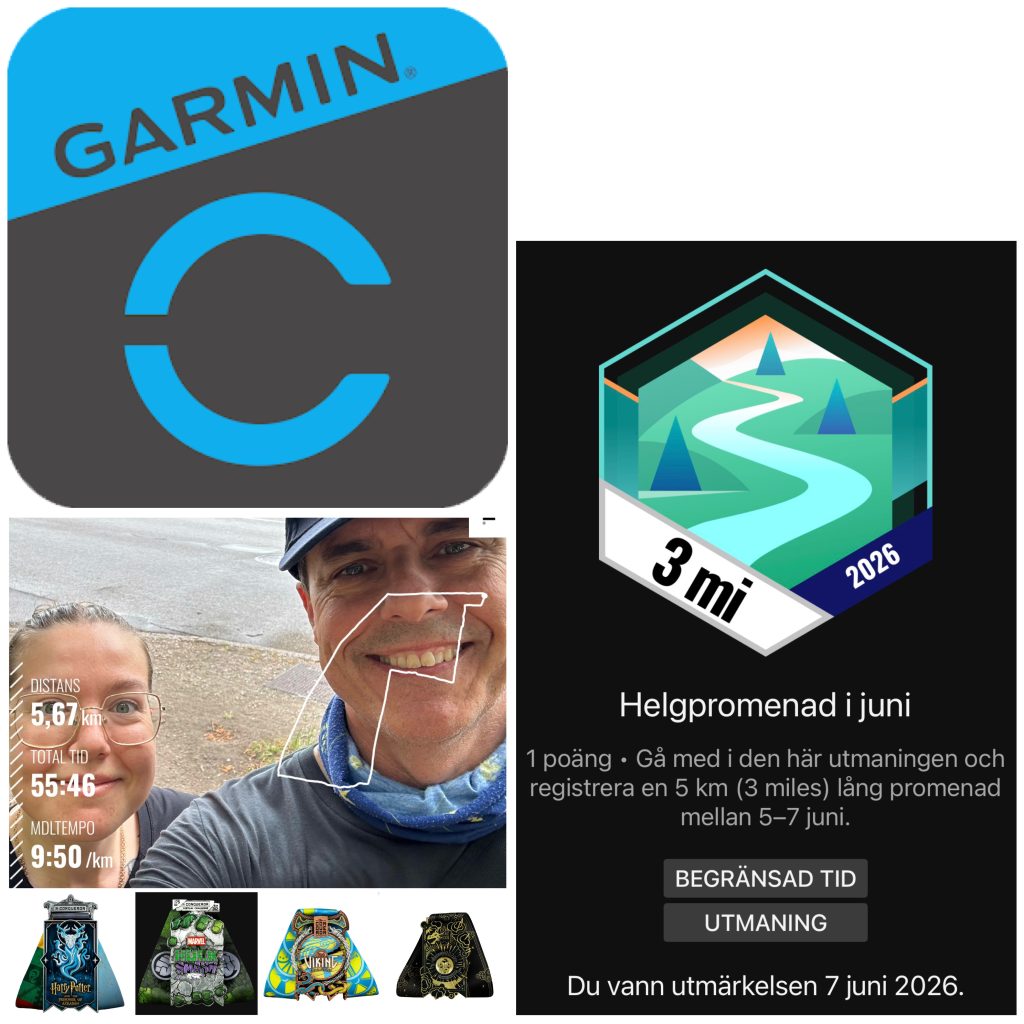
Söndagspromenad runt kyrkogården

Idag valde Ellie och jag att gå den långa vägen runt kyrkogården, med en extra sträcka runtom Annetorp, där jag bodde med mina föräldrar en tid.

Efter denna runda, fick vi ännu ett vykort från vår Harry Potter utmaning – Chamber of Secrets.