Det femte i ordningen av vykorten från The Conqueror Events utmaningen ”Space Race – To the Moon”, kom när gårdagens steg hade registrerats.
Gabriel ligger fortfarande ca: 10% före mig och jag har kommit till 48%.
Three astronauts, Gus Grissom, Ed White, and Roger Chaffee, prepare for a pre-flight test on January 27th, 1967. A fire starts, probably from an electrical fault, and sweeps through the module – unfortunately, all three men are killed. NASA reels in shock from this disaster, and the American space programme takes a great hit to its confidence; the mission intended to test the hardware being used to reach the Moon was unable even to make it off the ground, and the accident has cost the lives of three young men. What makes it worse is that the Apollo crew had previously expressed grave doubts about the safety of the aircraft, especially concerning the amount of flammable material in the cockpit (especially dangerous as the high oxygen concentration in a space capsule makes it highly combustible), loose wiring hanging from the cabin ceiling, and the poor escape hatch design, which opened inwards, slowing their evacuation.
On the other side of the Atlantic, in the same year, the story repeats itself with the launch of the Soyuz 1 rocket. This is the first manned spaceflight mission the Soviets have attempted since the death of the visionary head of their spaceflight programme, Sergei Korolev, in 1966. Though the Soyuz completes its mission, as its commander, Vladimir Komarov, prepares to make his re-entry to Earth, the parachute in his capsule fails to deploy, and he crashes to the ground. Later declassified Soviet documents reveal that although over 203 design flaws were reported by Soyuz I engineers, and previous test flights had uncovered serious failures, the Soviet Politburo overruled these concerns, as well as a pleading note from Yuri Gagarin asking them to delay the mission, as they wanted it to fly on Lenin’s birthday.
These twin tragedies seriously rocked the confidence of both NASA and the Soviet Space Programme. They are also a reminder of the human cost of the two nations’ ideological battle. As the Soviet Union tried to maintain its lead in the race against a rapidly advancing USA, and as the Americans desperately tried to catch up with their rivals, serious safety concerns raised by the crews and their technicians were ignored or brushed aside.
The disasters prompt a more serious focus on the safety of their crews on both sides of the Iron Curtain. The failure of the Soyuz I launch meant the Soviet authorities enforced stricter measures to ensure the safety of the Soyuz 2 and 3 crafts, and NASA delayed another manned mission until Apollo 7 in late 1968. With this major setback, the death of Korolev, and the huge advances being made by the Americans, the Soviets begin to rethink their mission. They begin to scale back their moonshot and never publicly acknowledge a desire to send a man to the Moon, instead pivoting towards developing space stations. As the Soviets pull back, the Americans pull forward.
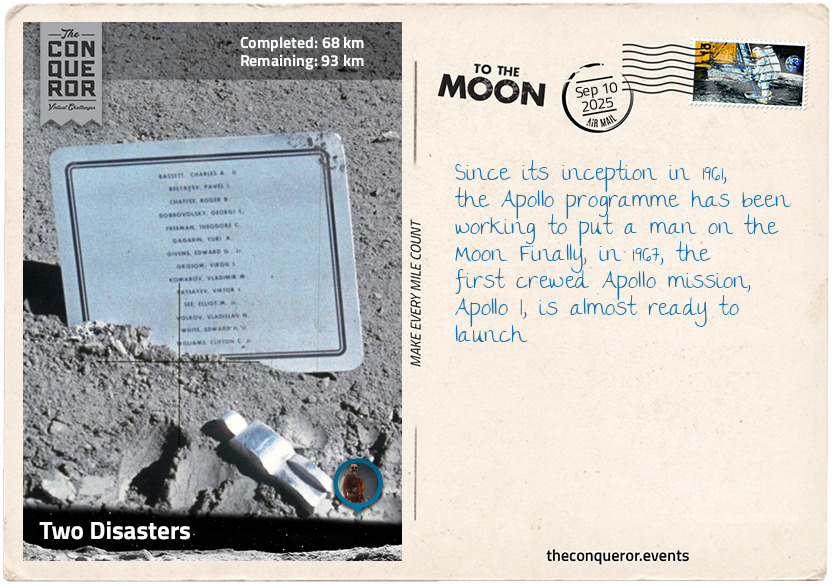
Years later, the names of these astronauts and cosmonauts who lost their lives in the service of space exploration would be commemorated on a plaque placed by Neil Armstrong on the surface of the Moon, which you can see in the image of this postcard.