Efter att ha varit ute på mitt ”Långpass” i min träning inför Midnattsloppet, kom det ett vykort från Space Exploration. Det var ett tufft pass, där jag på något sätt skadade min höft på höger sida. Fick halta hem från Djupadalskolan och kunde knappt stödja på benet!
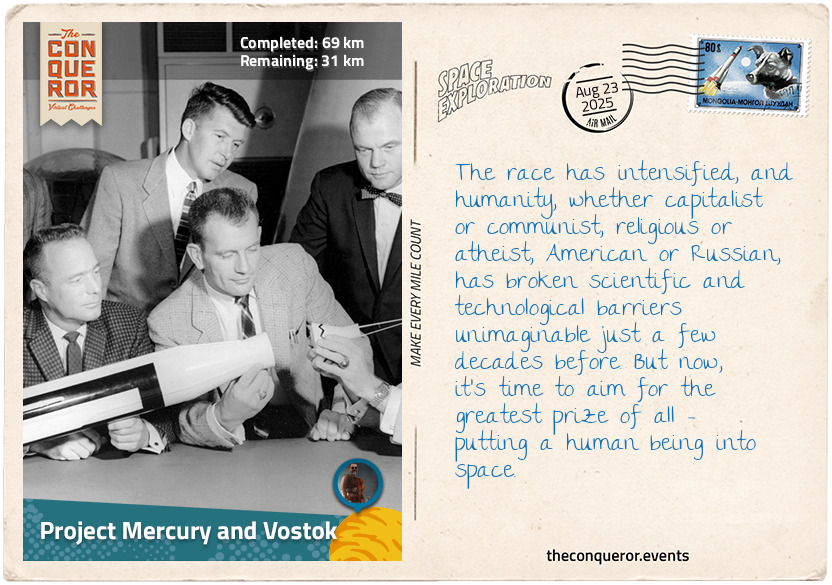
Just a few months after NASA’s formation, the USA announces Project Mercury, which aims to send a human being into space. In the USA, a new term is coined – astronaut, a traveller of the stars. The project is named after the Roman god Mercury, the god of travellers and messengers.
In the USSR, the Vostok programme begins, aiming for the same goal as the Americans – to put a person into space. Here, another new term is coined – cosmonaut, a traveller of the cosmos.
Korolev leads the design of the state-of-the-art Vostok. It is equipped with all the life support systems necessary to keep someone alive beyond our atmosphere: an ejector seat in case of emergency, a heat shield for re-entry, and a remote control system so that the mission can be guided from ground control. Finally, the theoretical cosmonaut will be equipped with a parachute, so that as they land, they can eject and splash down safely.
In 1960, the Soviets manage to send a dog up into the heavens, and then happily back down just in time for dinner and a long nap, proving that Earth organisms can survive in space. Belka and Strelka spend 24 hours orbiting the Earth and return home with their tails wagging. A year later, when Strelka has a litter of puppies, one of them, named Pushinka (meaning ‘fluffy’ in Russian), is given to President John F. Kennedy as a gift.
Following the pawprints of the first brave canine cosmonauts, the Soviet Union is now mere months away from becoming the first civilisation in world history to breach the barrier of space and ascend beyond our little blue world.