Even so, clamouring among press, people, and politicians, and a pervading sense of national humiliation and paranoia in the country, make it impossible to brush the problem away.
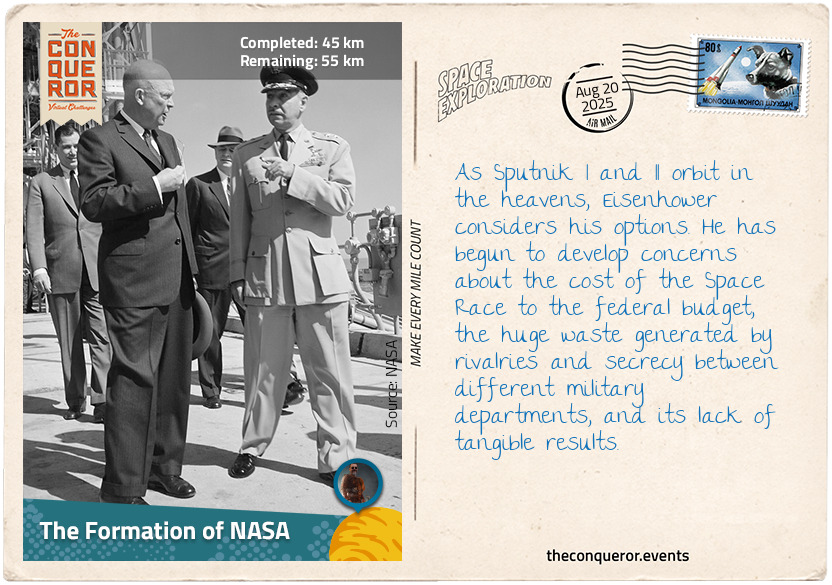
The Americans are immediately jolted out of complacency and into action. In October 1958, responsibility for space exploration and research is taken from the military and given instead to a newly created civilian federal department – the National Aeronautics and Space Administration, better known as NASA. This is the first step in the slow evolution of the Space Race out of the narrow confines of the Arms Race. NASA, as a civilian institution, claims that its primary aims are scientific research, technological advancement and the exploration of space.
Eisenhower has, to a small extent, demilitarised the Space Race. He now asks the Soviets to compete on new terms. Will they meet the new Space Race? Where the superiority of capitalism or communism is not proven by how powerful one side’s weapons are, but by how capable the system is of mobilising its citizens’ talents and marshalling its resources, of educating scientists and engineers who can push the boundaries of human knowledge, and of capturing the hearts and imaginations of the postcolonial states who are attempting to decide their own political trajectories.
The Soviets are firm in the belief that a society that has overthrown capitalism and is working towards building communism has advanced socially, culturally, politically and morally beyond any capitalist society. For the ideologues in the CPSU, there is no better way to prove this principle than to push the frontiers of human knowledge and surpass the far richer Capitalist West in technological achievement. By developing technologically, they aim to place themselves ahead of the Americans as the superpower that will trailblaze our planet’s future.
Still, the Cold War persists, and both sides continue to research the military applications of space travel. In 1960, the Soviets begin the Zenit project, which aims to use satellite technology to spy on the Americans. For their part, the USA has surrounded the USSR with military bases, many of them nuclear armed, and continuously sends out its U2 spyplanes, which can fly over 70,000 ft in the air, far above the altitudes that the Soviet radar and jets could reach, over Russia.
NASA’s creation opens a new chapter in the Space Race. Now there are new stakes, new priorities and new aims. From the bitter and paranoid years of the arms race, a more good-natured competition arises with exploration as the purported aim of the development of space technology.
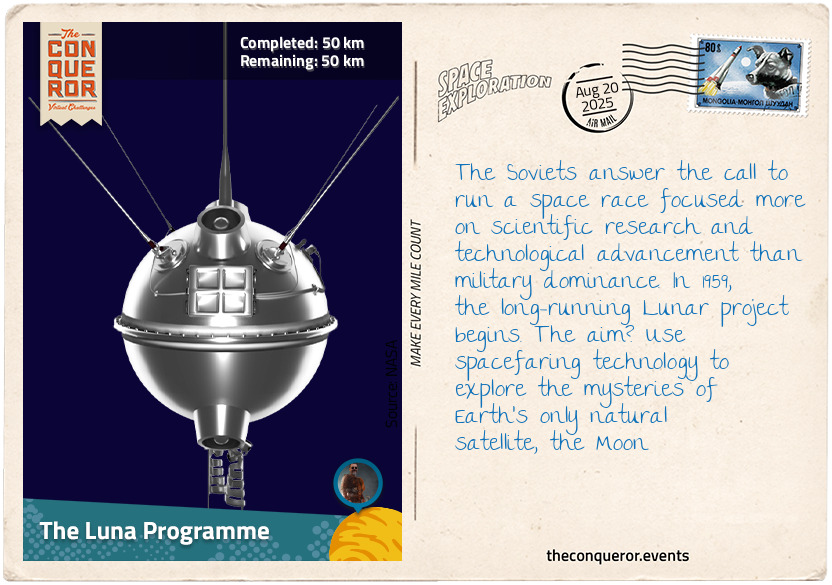
On 2nd January 1959, Luna I is launched. The aim is for the craft to make contact with the Moon and deposit on its surface two pennants bearing the hammer and sickle, the international symbol of communism. It is equipped with an array of sensors intended to measure the pressure both inside and outside the spacecraft, the radiation of cosmic rays, and the magnetic fields of both the Earth and the Moon.
Luna I launched, reaching speeds of over 25,000 miles per hour. As it nears its target, its guidance system fails, and it passes by, missing the Moon by over 3,725 miles (5,995 km). Still, it is fast and powerful enough to break free of Earth’s orbit, and it flies through open space before being caught by the gravity of the Sun, and pulled into a heliocentric orbit, where it still is today.
The project is, on paper, a failure, but at the same time, a resounding success, becoming the first object from our planet to escape Earth’s gravity. Soviet propagandists immediately get to work. The project is quickly given the nickname ‘Mechta’, meaning ‘dream’ in Russian, and they begin to refer to Luna I as the world’s first ‘Cosmic Ship’. And so, the world sees it, communism has produced the first spaceship, seven years before the USS Enterprise is launched on American television screens.
Eight months later, Luna II is launched with the same aim. This is actually the sixth Soviet probe aimed at making contact with the Moon; the four failed attempts preceding Luna I are kept as a state secret. Sixth time’s a charm, and Luna II successfully reaches the surface of the Moon.
Then Luna III is launched. This craft is tasked with orbiting the Moon itself and collecting photographs of the dark side of the Moon, the side of the satellite that always faces away from the Earth. The success of this mission means that for the first time, humans see the other side of our Earth’s satellite. The Soviets, on grainy but still detailed black and white film, manage to photograph around 70% of the dark side of the Moon’s surface.
Throughout history, humans have wondered about the Moon. The Sumerians believed it was the god Nanna, father of the Sun. To the ancient Greeks, it was the chariot of the goddess Selene, and its perfect silver light came from the shining pelts of her two snow white horses. And, even as the Soviets brushed our satellite with their fingertips, many people across the world believed that the Moon was the cause of madness, or told stories about its strange ethereal light transforming men into wolves. Now, for the first time in human history, its secrets are almost within reach.