Det går fort med stegen i Space Exploration, och idag kom det ytterligare två vykort, eftersom jag passerat 40% av den totala sträckan.
In 1956, Khrushchev convenes all the most important members of the CPSU and delivers his Secret Speech. In it, he reveals the true extent of Stalin’s crimes: the executions of thousands, the deportation of entire ethnic groups to forced labour camps, the tortures and the forced confessions. He accuses the Stalinists of fostering a cult of personality around their leader, of crimes against humanity, of stifling culture and of betraying the ideals of Marx and Lenin that founded their state. Khrushchev promises destalinisation, the relaxation of censorship and state repression, the release of political prisoners and the return of deported populations.
The USSR enters a new era, but the rivalries with the USA remain unchanged. The second Red Scare has gripped America, and Senator McCarthy presides over a witchhunt that imprisons and humiliates anyone even suspected of communist sympathies.
In 1953, General Dwight D. Eisenhower becomes president. Eisenhower enters the White House as the colonies of the old Imperial powers of France, Britain, Portugal, and the Netherlands begin to win independence. In these poor and exploited nations, communists and economic nationalists argue that natural resources should be owned by the state and kept out of the hands of foreign corporations. Under the aegis of the Dulles brothers, the CIA grows from a small government department employing just a few hundred people to a huge network of intelligence operatives with a single aim beyond national security: to contain the spread of communism. Following the Truman Doctrine, the bigwigs in the State Department believe that, if left unchecked, a communist revolution in one nation will, domino-like, spark more and more revolutions across the world.
In the new postcolonial states, if the CIA gets even a whiff of a country turning communist, the Cold War often turns hot. The USA’s doctrine of containment will bring war, coups, atrocities and dictatorships to Indonesia, Vietnam, Cambodia, Laos, Chile, Argentina, Brazil, Guatemala, Cuba, Iran, Nicaragua, and many, many others.
However, the US also wishes to combat communism through soft power, by winning hearts and minds, and so it aims to use its advancements in the Space Race to demonstrate the superiority of capitalism to the postcolonial world and to prevent them from turning to the Soviet Union and left-wing ideals.
Without Stalinist repression, Krushchev needs a new way to keep the people of the Soviet Union onside and to direct their attention away from the great wealth and high standards of living that capitalism is producing in the West. The Soviet state provides healthcare, education, energy, leisure time and basic food free of charge or at heavily subsidised rates, but everyday comforts are practically unheard of. They have few refrigerators, washing machines, or Levi Jeans; food is still rationed and of poor quality, as is housing, and it takes years of waiting to be provided with an apartment or a car. Worse, Krushchev’s Virgin Lands programme, intended to cultivate the vast Central Asian steppe, has ended in ecological, economic and humanitarian disaster, throwing into question the efficacy of a centrally planned command economy. Finally, political repression puts limits on self-expression and free thought. Despite destalinisation, those in the USSR who stray too far from the party line still find themselves in the frozen prisons of Siberia, or in exile abroad.
The Soviet people, and those in the Global South who are deciding the direction of their new nations, need a real reason to believe in communism. The Soviets believe that one can be found in the ability of the USSR to match its much wealthier rival in technological advancement. In addition to its role as a military deterrent to the USA, the Soviet Rocket Programme becomes a way for Soviet citizens to feel proud of their society, to deflect niggling doubts about Soviet-style socialism’s workability and to demonstrate once and for all to the world that Soviet-style communism is the superior system.
Eisenhower has no wish to provoke an all-out war with the Soviet Union, but his foreign policy aims to isolate and threaten it. He instructs the military to focus on the nuclear deterrent, building a huge stockpile of the weapons. Khrushchev, for his part, preaches ‘peaceful co-existence’, whilst at the same time ordering the expansion of the Soviet Missile Programme in the hopes of creating a missile that can strike the heartlands of the United States.
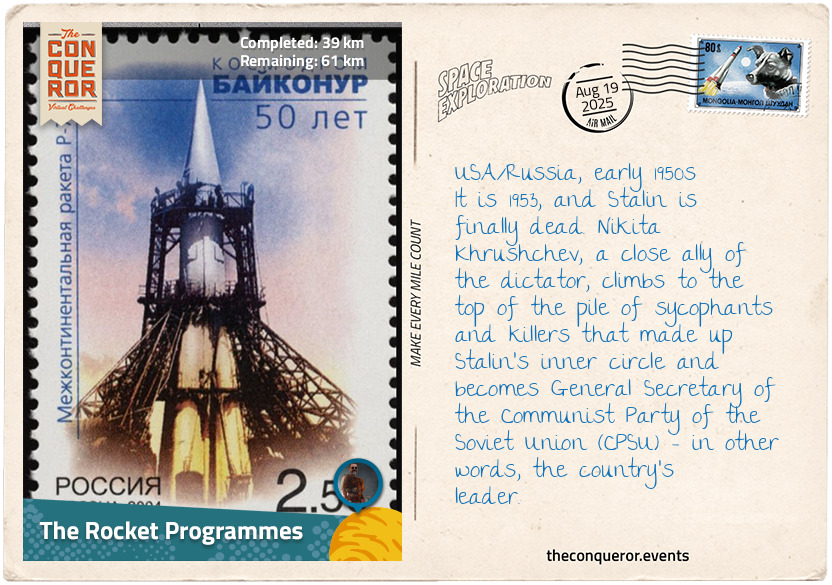
Sergei Korolev has been hard at work. Not only is his project top secret, but so is his name; the identity of the head of the Soviet Space Program will be a mystery until the end of the Cold War. One Winter’s day in the mid-1950s, he invites the high-ups of the Soviet Praesidium to his hidden laboratory to show them something that will change the balance of power. Korolev and his chief rocket engineer, Valentin Glushko, have developed the prototype for the R-7 Semyorka, the world’s first intercontinental ballistic Missile (ICBM), capable of carrying a nuclear-tipped warhead over 7400 miles (12,000 km), putting the continental United States well within range. It is not until 1957 that the prototype is successfully tested, but it’s worth the wait. Now, with the push of a button, the USSR has the power to send a missile to the US in minutes. Additionally, the Soviets can also counter the huge fleet of bombers that the USA possess using missiles, which are far, far cheaper, changing the goalposts in the arms race and mitigating Soviet material disadvantages.
In the sense that both nations now have the means to destroy their rival just as easily as the other, this technological achievement means that the USSR has equal nuclear capabilities with the US. Most important for our story, however, is that the rocket also allows the transportation heavy objects into outer space. Though this feature is intended at first to carry a nuclear warhead, soon, other possibilities arise, opening up the potential for the Soviets to do things only dreamt of in science fiction – sending an artificial satellite into Earth’s orbit, or even, a terrestrial being to the stars.
 Milestone Treeplant
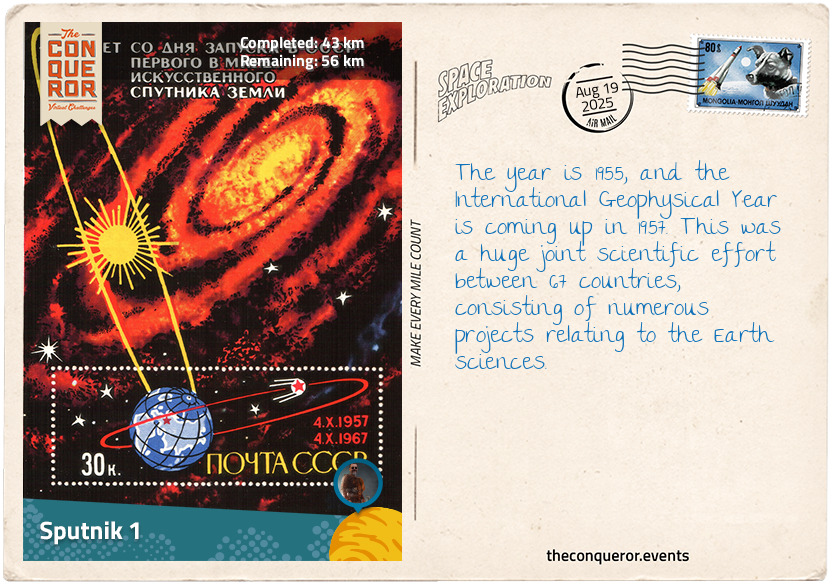
Both the United States and the Soviet Union participate, marking the end of over a decade of scientific secrecy between the two nations. Now, to celebrate the IGY, Soviet and American scientists come together to compare and display scientific advances in a variety of fields.
The United States announces Project Vanguard: it will send an artificial satellite to space within three years, joining the lonely Moon as the only other permanent object in Earth’s orbit. Rather predictably, the Soviets make a similar announcement a few weeks later. The race is on.
The US are still unaware of the R-7, which has provided the Soviets with a huge headstart. The Soviets, on the other hand, are unaware of the early U-2 spy planes that the Americans fly over their country, and intelligence starts to come in: the Soviets are training about three times as many rocket scientists per year as the USA. But the American high command is not yet nervous; they have the bulk of the German rocket technology, the expertise of the Operation Paperclip scientists, and far, far more money.
In New Mexico, work begins on Project Vanguard. But progress is slow, and failed launch follows failed launch. Unlike the Soviets, who perform their rocket tests in secrecy, the Americans choose to let journalists and photographers attend launches. But this relative openness backfires as the press begins mocking von Braun and his colleagues’ persistent failures, dubbing them ‘flopniks’ and criticising them for wasting taxpayer dollars.
Then, on October 4th, 1957, the Soviets claim a surprise first victory in the Space Race. Using Korolev’s R-7 ICBM, a gleaming chrome sphere is launched into low orbit. This is Sputnik I (Sputnik meaning ‘satellite’ in Russian). It orbits Earth for three months, sending a radio signal back to a receiver in Moscow and then runs out of battery before plummeting to Earth, burning up in the atmosphere.
Then, another blow to the USA in the race. Just a few months after their launch of Sputnik I, the Soviets send a stray dog picked up from the streets of Moscow into space. Laika, as she was named, became the first being in world history to transcend the terrestrial realm. Poor Laika was never intended to survive her journey as the technology to bring the shuttle back did not exist, but she proved to Soviet scientists that animals could theoretically survive in the zero-gravity, high-radiation environment of space. Suddenly, a new frontier is opened up that seems to stretch the human imagination, perhaps leading it beyond narrow military concerns: Is human space travel possible?
The result is panic, and the Sputnik Crisis begins in the American Press and politics. Reports come in of the rocket’s power. The satellite the Americans were hoping to launch weighs around 22 pounds (9.8 kg), yet Sputnik I comes in at a hefty 184lb (83 kg). Calculations are made: American rockets at the time were capable of producing about 150,000 pounds-force of thrust, but to launch something as heavy as Sputnik I, engineers would need almost 1,000,000 pounds-force. Even worse, Sputnik’s launch proves the power of the R-7 rocket. There is no denying it anymore: if the Soviets can send a satellite into space, they can send a missile. If they can send a missile into space, then they can send one to the USA.
With the launch of Sputnik, the Soviets win a huge propaganda victory, proving to the whole world that the American homeland is vulnerable to a nuclear strike and showing that the ingenuity, intelligence, and talent produced by their political system are a match for the Americans. Eisenhower attempts to downplay the implications of the launch, but his nation is far further behind than it thought. The USA wakes up to a new reality – the vast Atlantic and Pacific oceans no longer offer them protection from Soviet weapons.