Ett nytt träd planterades då jag passerat 20% av den totala sträckan i The Conqueror Events Challenge Space Race – Space Exploration.
 Milestone Treeplant
Samtidigt, fick jag även det tredje och fjärde vykortet.
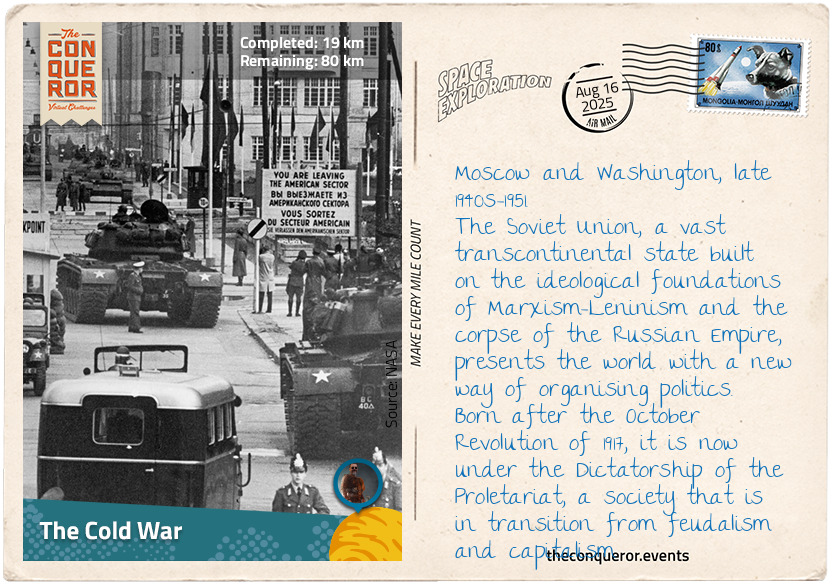
Central to Soviet philosophy is historical materialism. This theory, first put forward by the philosopher Karl Marx, posits that power rests in the ownership of the means of production (that which produces goods: land, factories, tools, etc) and that history moves forward in stages, propelled by class struggle as those who lack access to the means of production to redistribute them. The Soviets point to how merchants of the cities replaced the Medieval nobility as the rulers of the world, creating liberalism, democracy, capitalism and the urban working class. Now that the revolution is won, and the means of production are in their hands, the working class will replace the capitalists.
The Soviets aim to abolish private property (wealth and materials used to invest in business ventures to create more wealth, not personal property such as cars, clothes, toothbrushes, etc), and to manage workplaces and the economy democratically (though in practice, the Soviet system favours top-down, relatively undemocratic central planning). The state announces its international mission to create a new human culture that is equal, free from oppression, class distinctions, and economic exploitation, where work and wealth are apportioned according to the basic principle of from each according to their ability, to each according to their needs.
But the reality is not so utopian. Almost as soon as the Bolshevik Revolution triumphs, a bitter civil war begins. Those who support the old monarchy fight the revolutionaries. Western powers, including the USA, the British and the French, who are worried about their own workers’ revolutionary desires, invade the fledgling state. The Tsarists and the invaders are driven out, but in 1924, Lenin dies, and Joseph Stalin begins to consolidate his grip on power, which will result in a brutal dictatorship. Ideological enemies are purged in mass executions, millions are exiled to frozen labour camps in Russia’s arctic north, and Ukraine is plunged into a horrific famine.
Stalin rules over the USSR as an even more grotesque criminal begins to dominate Europe. Adolf Hitler’s Nazis invade the Soviet Union in 1941, besiege its second city, Leningrad, devastate the countryside and waste cities.
The USSR allies with the Americans and the British, and, after winning the Battle of Stalingrad in 1943, pushes the Germans back, entering Berlin in April 1945. The Soviet people have played the biggest role in defeating the Nazis, and they also suffered the most. Soviets and Americans both have bled for peace, but now their leaders set the stage for a new conflict. Franklin Delano Roosevelt, President of the USA and architect of the New Deal, is replaced by Harry S. Truman, a fervent anti-communist. He sees the Soviet Union as a threat to world peace and American dominance, and believes that the Soviets wish to spread totalitarian communism around the world and subvert liberal democracy.
The Soviets confirm these fears. They install communist governments in all the nations they have liberated from the Nazis, with little attention paid to the wishes of their citizens. East Germany, Poland, Romania, and many others are turned into client states. Visiting the US in 1946, Winston Churchill states that “an iron curtain has descended across the Continent”, on one side, the free democratic West, and on the other, the communist East, separate and irreconcilable. In 1946, the Long Telegram is sent from a US diplomat in Moscow to Truman, accusing Stalin of attempting to enslave Europe and spread communism across the world.
The USA responds forcefully, though it is still unclear if Stalin has any designs on world domination whatsoever. The CIA uses covert tactics and voter suppression to successfully undermine communist movements in Italy and France who are about to be democratically elected, they support the far-right dictatorship in Greece in its civil war against communist revolutionaries, and they allow many high-ranking members of the Nazi party to remain in office, closing off control of Western Germany to the left and allowing war criminals to escape justice. Finally, they initiate the Marshall Plan, a massive program of financial aid to help rebuild Western European countries, on the understanding that they remain within the American sphere of influence.
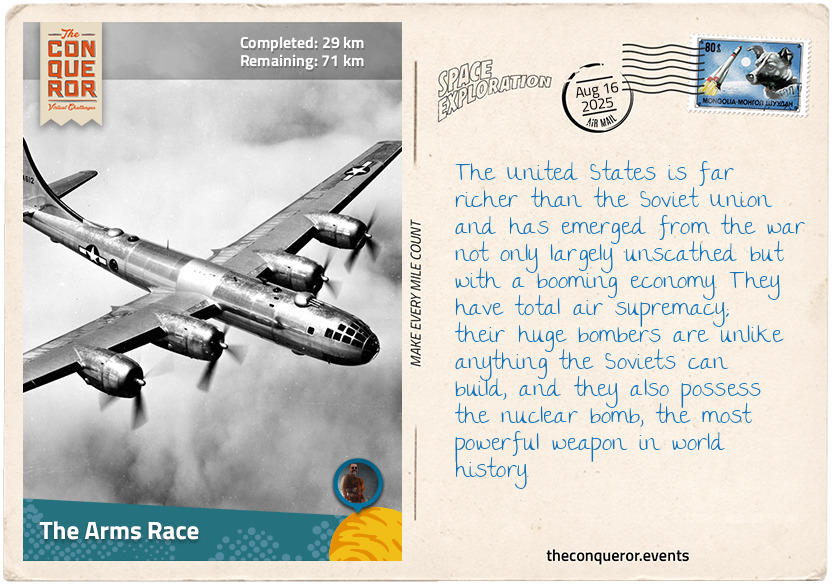
A climate of fear grips the Soviet Union. In 1949, the USA flies three B-29 Superfortresses (the same craft used to drop nuclear bombs on Japan) in tight battle formation deep into Soviet airspace, their undersides painted white to reflect the light from a nuclear explosion. For a moment, the Soviets expect annihilation, but the bombers turn round, satisfied in their demonstration of power.
The Soviet Union must level the playing field. In 1949, they complete their first successful test of a nuclear bomb. In occupied Germany, they race to steal as much machinery and schematics as they can. In Mittlewerk, at first they find nothing, but then, in a vault missed by the Americans, they find V-2 schematics, and even materials for a more advanced rocket, one that could travel across the Atlantic.
Enter Sergei Korolev. Famous for his work on early Soviet cruise missiles, he fell foul of Stalin and has spent the last six years in labour camps and prisons. Now, traumatised and emaciated, he has been plucked out, given his freedom, and placed in control of the Soviet Rocket programme. His task – work backwards through the bewildering mess of the Nazi schematics and build a rocket that can enter space and drop a nuclear-tipped warhead on the continental United States.
Stalin believes that once this is achieved, the USSR will be safe. A nuclear attack on one nation will result in a retaliatory nuclear strike, and the world will end. The price is simply too high for one nation to attack first. This is Mutually Assured Destruction – the twisted, dangerous logic that underpins the new Cold War. After the Soviets make their first successful test of a nuclear bomb in 1949, the two superpowers cannot fight each other directly. Instead, the battle will be fought in the realm of culture, scientific development, and in the anticolonial struggles of the global South, which is now emerging free from European colonialism and looking for an ideological path to a better future. The arms race grows out of this conflict, and following it, so does the Space Race.